On May 6, 2026, policymakers, industry leaders, the EU Ambassador to Bangladesh, and representatives of H&M Group and BESTSELLER gathered at Hotel InterContinental in Dhaka for a seminar titled ‘Accelerating Circular Transition through SWITCH2CE Pilot Pathways in Bangladesh.’ The event, jointly organised by the Ministry of Commerce and BGMEA, was ostensibly about progress. What the data presented revealed was a missed opportunity on a staggering scale.
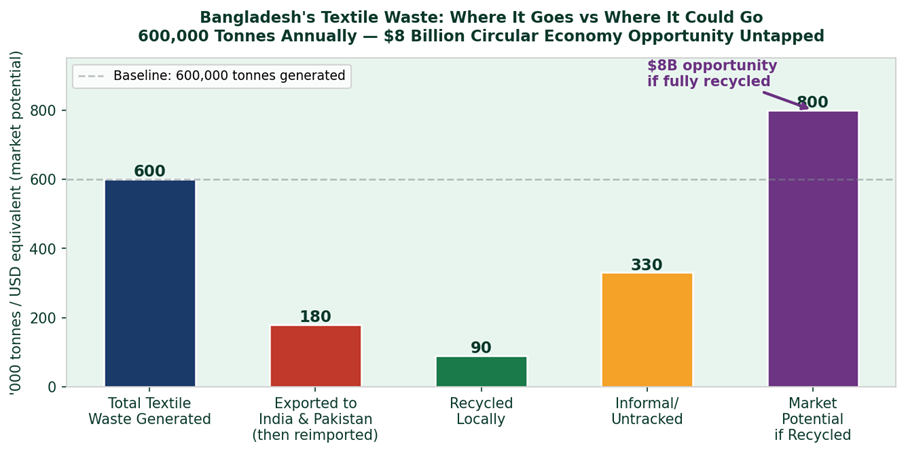
generated annually, only 30% recycled locally, significant volume exported to competitors, vs the $8B circular economy value if fully recovered
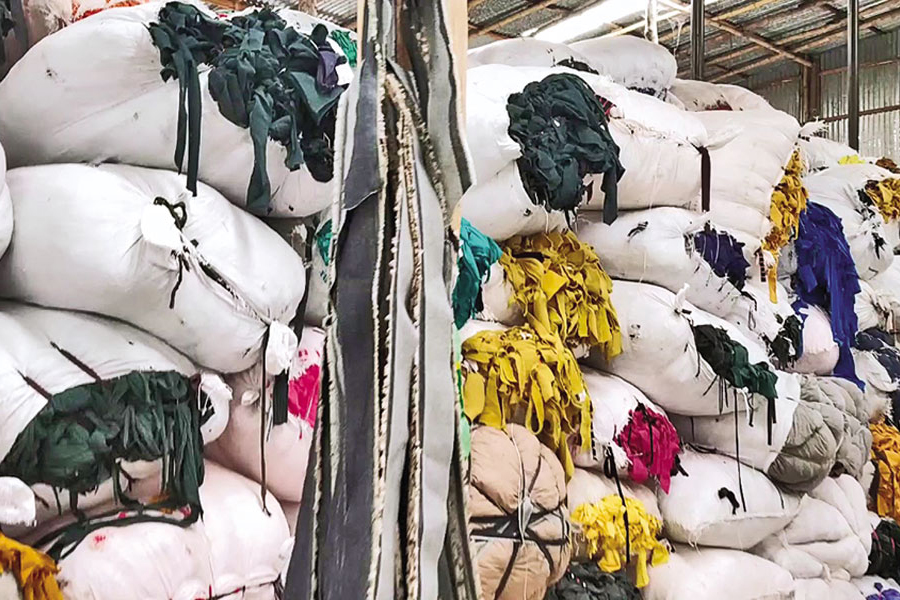
Bangladesh generates approximately 600,000 tonnes of textile waste every year — pre-consumer cutting scraps, defective materials, end-of-line fabric. BGMEA Vice-President Vidiya Ammrit Khan set out the arithmetic clearly: recycling the entire volume could generate a circular economy worth nearly $8 billion annually. At present, Bangladesh recycles roughly 30% of its cotton-based cutting waste — and a significant portion of even that modest figure is exported to India and Pakistan before being reimported as recycled yarn at a substantially higher price. Bangladesh creates the raw material. Competitors capture the margin.
“Recycled materials are still treated as waste rather than as a resource — despite an estimated market potential of $4–5 billion.” — EU Ambassador Michael Miller, May 6 2026
The EU Ambassador, Michael Miller, was specific about why this matters commercially beyond the domestic economy. Europe produces over 5 million tonnes of textile waste annually. The EU’s 2022 Strategy for Sustainable and Circular Textiles mandates eco-design requirements, extended producer responsibility, mandatory Digital Product Passports, and stricter rules on greenwashing. Bangladesh — which generates 600,000 tonnes of the EU’s supply chain waste — is inside the regulatory perimeter of every one of these requirements, whether it has domestic recycling infrastructure or not.
The Digital Product Passport is the most immediate commercial deadline. From 2030, every textile product sold in the EU must carry a digital record of its materials, their origin, and their recyclability. Bangladeshi factories that cannot demonstrate traceability of their fabric inputs — including waste disposal — will face compliance barriers in their largest export market. BGMEA President Mahmud Hasan Khan acknowledged the challenge directly: ‘The textile industry is one of the most polluting and resource-intensive industries, and only 5% of pre-consumer textile waste is recycled locally.’
The Commerce Minister framed it in terms that should resonate with every finance professional and policymaker: ‘The transition to a circular economy is no longer merely an environmental issue; it is now a key prerequisite for strengthening future competitiveness.’ He confirmed the Ministry’s commitment to finalising the National Strategy on Circular Economy for Textiles by end of 2026.
Bangladesh has 17 pilot recycling factories currently operating. The infrastructure for industrial-scale recycling requires formalised waste collection systems, investment in chemical and mechanical recycling technologies, and a policy environment that makes recycling economically competitive with virgin material. None of these are yet in place at scale. The countries that build this infrastructure fastest — Vietnam, Turkey, India — will capture not just the recycling margin but the premium buyer relationships that circular compliance unlocks. Bangladesh has the waste. The question is who gets paid for it.