
 ESG in Banks & NBFIs
The securities regulator has cleared Tk 3,500 crore of bonds for five banks. Two of them, BRAC Bank's green bond and Bank Asia's sustainable bond, tie their proceeds to green and sustainable projects. A label is easy to print. Proof is harder.
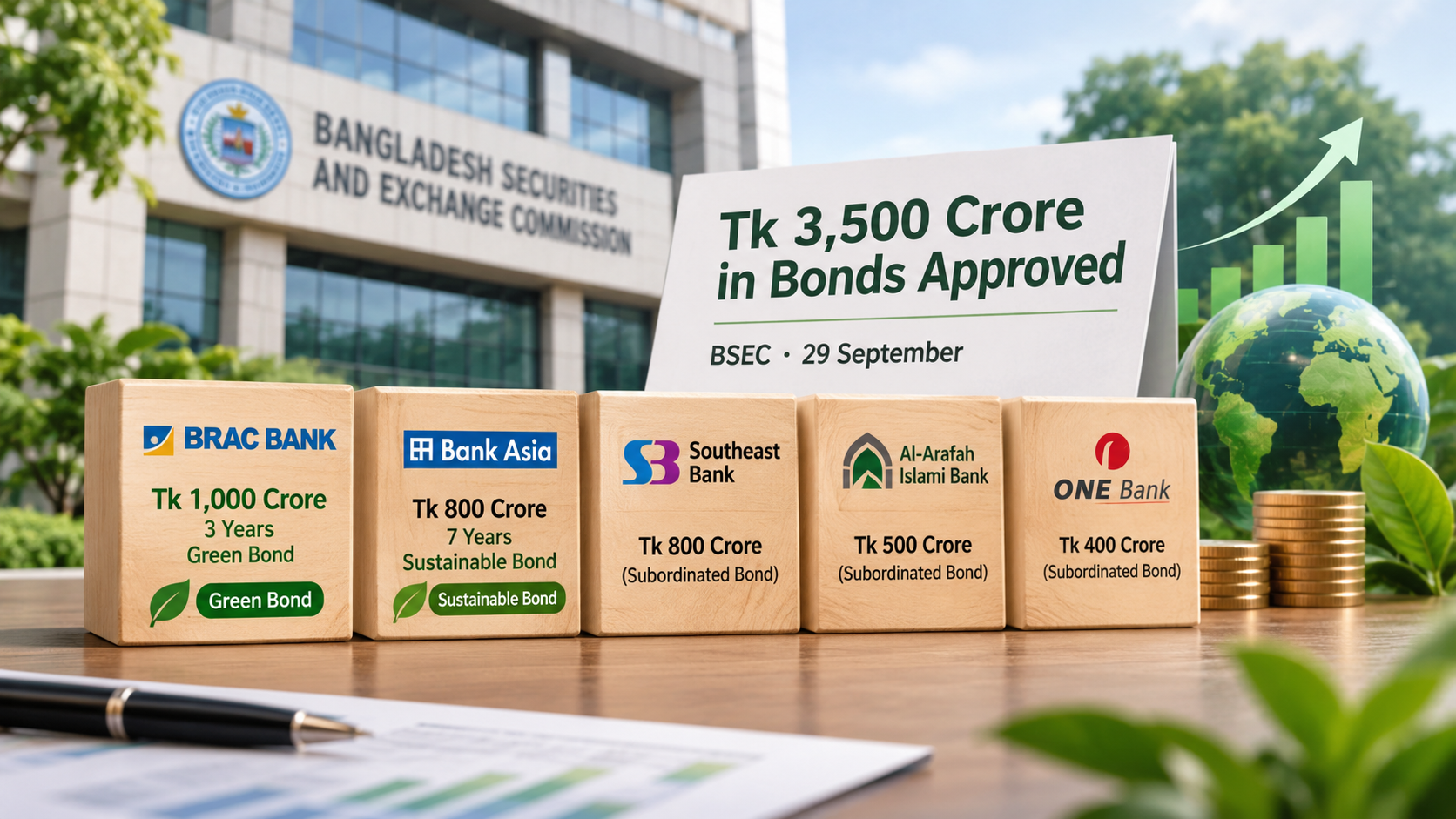
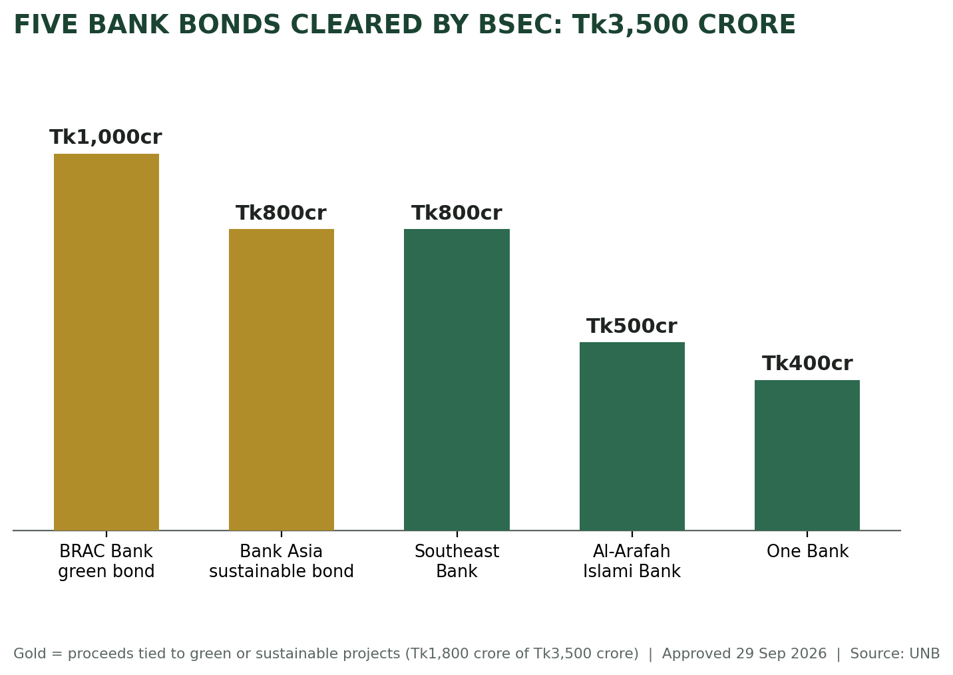
Bond sizes approved at BSEC’s 1031st meeting. The Tk1,800 crore total for the two labelled bonds is calculated from the reported amounts.
On 29 September, the Bangladesh Securities and Exchange Commission approved proposals from five commercial banks to raise a combined Tk3,500 crore through bonds. The decisions came at the commission’s 1031st meeting, chaired by BSEC Chairman Masud Khan. The stated aim is to strengthen the banks’ capital base. Look closer, and two of the five carry a green or sustainable label.
BRAC Bank received approval for a Tk1,000 crore, three-year, zero-coupon green bond with a probable discount rate of 8.5 percent. It will be placed privately with corporate entities, provident and gratuity funds, high-net-worth individuals and other eligible investors, with each unit valued at Tk10 lakh. The bank will use the proceeds for low-cost green financing to eligible clients. Prime Bank Investment is the trustee and IDLC Investments the issue manager.
Bank Asia’s Tk800 crore, seven-year, floating-rate sustainable subordinated bond was also cleared, at a coupon of the reference rate plus 3 percent. Besides bolstering the bank’s Tier-II capital, its proceeds will finance and refinance eligible green and sustainable projects.
The other three are subordinated bonds- Tk800 crore for Southeast Bank, Tk500 crore for Al-Arafah Islami Bank and Tk400 crore for One Bank. Four of the five, those of One Bank, Southeast Bank, BRAC Bank and Bank Asia, must be listed on the Main Board of the stock exchanges.
An approval is a green light to raise money. It is not proof that the money does what the label says. A green label is a promise about where funds will go, and keeping that promise means being able to show it- which projects qualified, how much was allocated, and what changed as a result.
That raises questions the approval notice does not answer. Who inside each bank defines what counts as an eligible green or sustainable project? Who tracks the proceeds until they are spent? And who reports back to investors, and in what format?
Investors who buy these bonds, from provident funds to corporate treasuries, will have their own reasons to ask. The banks that can answer clearly will find it easier to raise the next round. The ones that cannot may find that a label invites scrutiny rather than confidence.
Bond approval is only the starting point. Delivering on a green commitment requires the right people, robust processes, and verifiable evidence. Every institution issuing a green or sustainable bond must have the systems in place to prove where the money goes and what it achieves.
ESG in Banks & NBFIs Climate Change
 Regulation
Hivedemy turns ESG into short, hands-on lessons built and checked by professionals worldwide. Every lesson teaches first, then asks you to do the work, and every attempt gets a reason.