
 ESG Global Trends
The ISSB has trimmed some of the hardest edges of IFRS S2's emissions rules, from financed emissions to global warming potential values. The amendments apply from 1 January 2027, with early application allowed. For banks reporting under the new standard, the fine print is where the work lives.

IFRS S2, the ISSB’s climate disclosure standard, was issued in June 2023. Within two and a half years, its authors went back to adjust the emissions rules. On 11 December 2025, the ISSB issued targeted amendments to the greenhouse gas requirements, responding to application challenges raised during early implementation. They apply to annual periods beginning on or after 1 January 2027, and companies may apply them earlier.
The biggest relief concerns Scope 3 Category 15, the emissions linked to investments and lending. Entities may now limit measurement and disclosure to financed emissions as defined in IFRS S2, leaving out emissions associated with derivatives, facilitated emissions and insurance-associated emissions. BDO notes that the final text also requires a subtotal for financed emissions within the category.
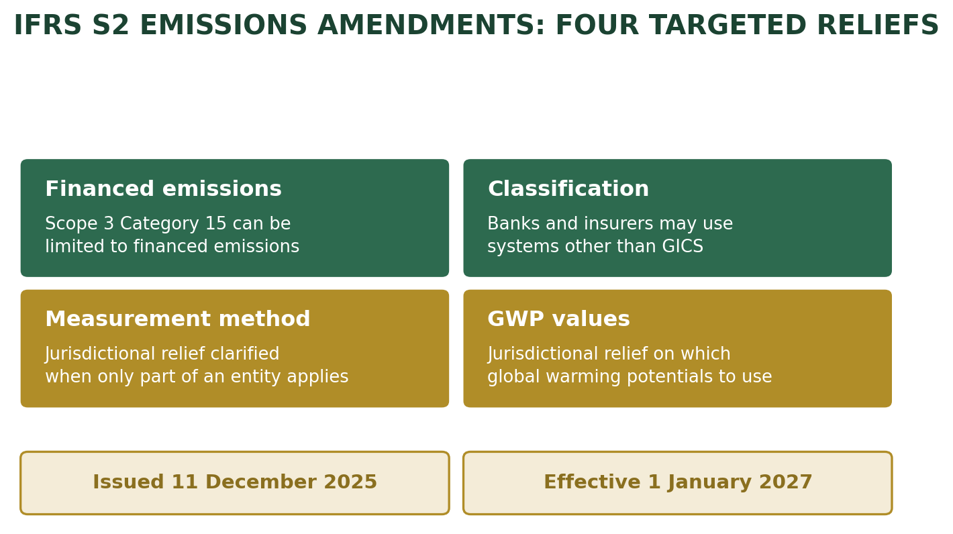
The four targeted reliefs in the ISSB’s Amendments to Greenhouse Gas Emissions Disclosures, issued 11 December 2025.
Banks and insurers get more room on classification. They may use systems other than the Global Industry Classification Standard to break financed emissions down by industry.
Two further reliefs deal with jurisdictions. One clarifies that relief from using the GHG Protocol is available when only part of an entity is required to use a different method. The other lets an entity use global warming potential values that its regulator or listing exchange requires, even if they are not from the latest IPCC assessment. Matching changes were made to financed-emissions metrics in three SASB Standards.
ISSB vice-chair Sue Lloyd said the amendments should bring real relief without significantly affecting how useful the information is to investors.
Why does this matter in Bangladesh? The Financial Reporting Council has adopted S2, and Bangladesh Bank has asked banks to report under the ISSB-aligned standards since a 2023 circular. For a lender, financed emissions are among the hardest numbers to produce. The amendments clarify what must be measured. They do not remove the need to measure it.
One further point is easy to miss. The amendments set the IFRS S2 effective date, but they do not set local adoption dates. Those belong to national regulators.
ESG Global Trends ESG in Bangladesh
 Climate Change
Hivedemy turns ESG into short, hands-on lessons built and checked by professionals worldwide. Every lesson teaches first, then asks you to do the work, and every attempt gets a reason.