
 Regulation
From 14 December 2027, products made with forced labour cannot be sold on the EU market, whatever their origin. Commission guidelines are out, a promised risk database is still missing, and companies are being told to prepare now. For exporters, proof will matter more than promises.
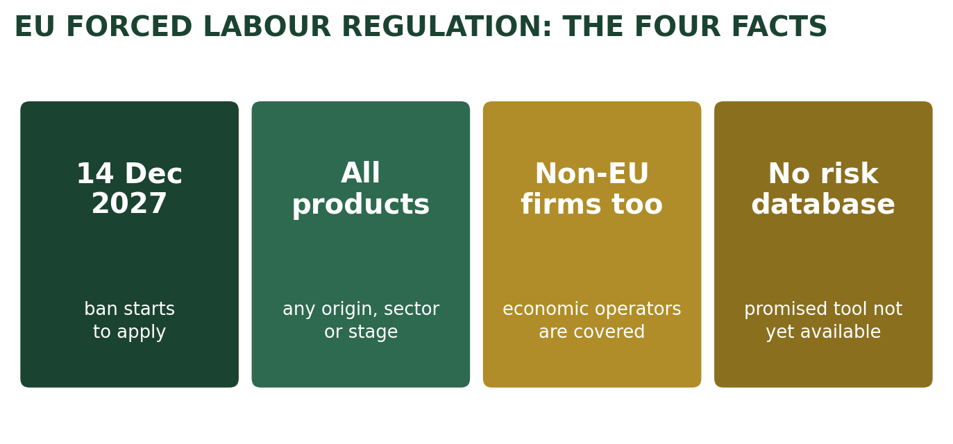
Key features of Regulation (EU) 2024/3015, as summarised by law firms Osborne Clarke, Baker McKenzie and Mayer Brown.
Europe is closing its market to goods made with forced labour, and it is not asking where they were made. Regulation (EU) 2024/3015 prohibits placing on the EU market, making available, or exporting products made with forced labour. It covers all products, whatever their origin, sector or stage of production, and applies to all economic operators, including those outside the EU.
The ban starts to apply on 14 December 2027. The Commission has now published guidelines on how it will work, and a notice setting them out appeared in the Official Journal on 3 September 2026.
Law firms stress one point above others. Due diligence is a useful tool, but the regulation sets an obligation of result. Showing effort is not the same as showing the outcome.
Enforcement will be risk-based. Authorities can act on complaints from civil society, trade unions and workers, and on a forced-labour risk database the Commission has promised but which is not yet available. Only ten member states have so far designated their competent authorities. Reports also indicate that products still on the market after the start date are caught, including stock held in warehouses.
The advice to companies is consistent- map your risk, and test your due diligence against internationally recognised, OECD-aligned frameworks before December 2027.
For Bangladesh’s garment exporters, Europe is a core market. Buyers who face this rule will want to know about recruitment practices, worker voice, subcontractors and the origin of materials, and they are likely to push those questions down the supply chain. A supplier that can answer clearly will be easier to buy from.
The deadline is more than a year away. But the evidence behind a clean answer, such as mapped suppliers, grievance records and documented checks, takes time to build.
Regulation Regulation
 Climate Change
Hivedemy turns ESG into short, hands-on lessons built and checked by professionals worldwide. Every lesson teaches first, then asks you to do the work, and every attempt gets a reason.