
 Decarbonisation
A $30 million loan to Envoy Textiles ties its terms to rooftop solar capacity and emissions reductions. It was ADB's first sustainability-linked loan in Bangladesh. A year on, it is a template for performance-based finance, and for what a borrower must be able to prove.

In October 2025, the Asian Development Bank signed a $30 million sustainability-linked loan facility with Envoy Textiles Limited, Bangladesh’s largest denim fabric producer. It was ADB’s first loan of this kind in Bangladesh, and a follow-on to the bank’s 2022 textile manufacturing project with Envoy.
A sustainability-linked loan works differently from an ordinary green loan. It is a forward-looking, performance-based debt instrument with predefined key performance indicators, assessed against sustainability performance targets. The borrower is not simply promising to spend money on a green project. It is committing to measurable results.
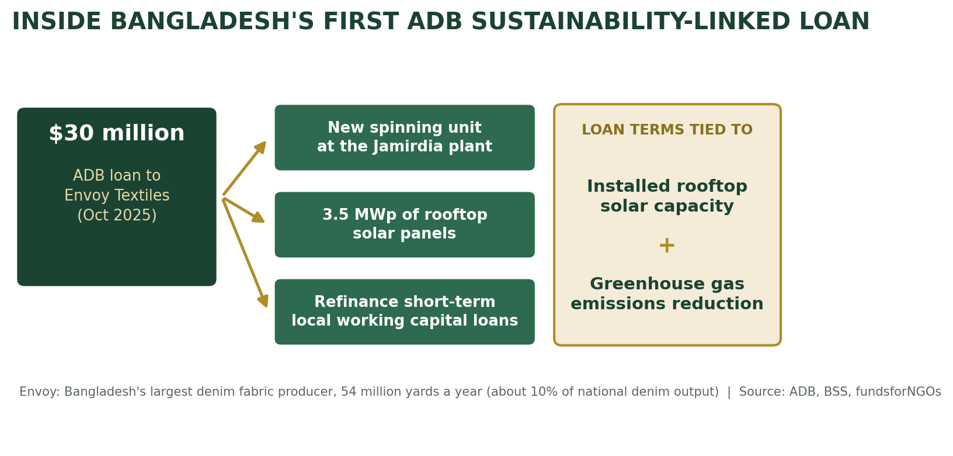
Use of proceeds and sustainability targets of the ADB–Envoy facility signed on 2 October 2025
For Envoy, the targets are total installed rooftop solar generation capacity and the amount of greenhouse gas emissions reduced. The loan proceeds will fund the design and construction of a new spinning unit at the Jamirdia plant to expand annual yarn output, install 3.5 MWp of rooftop solar panels, and refinance short-term local working capital loans.
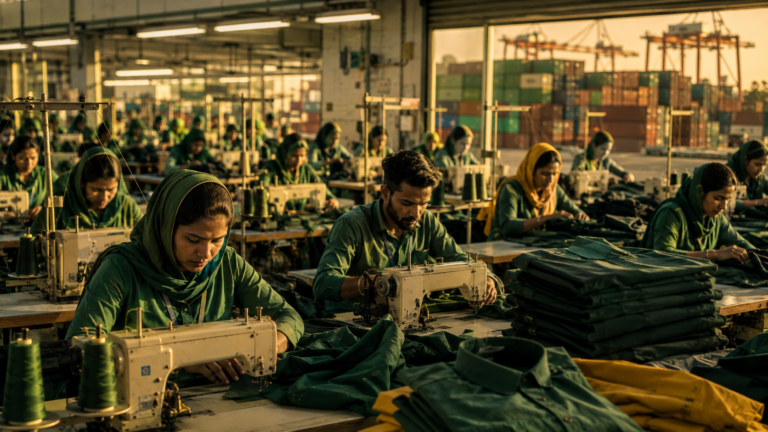
Envoy is not a small player. It has an annual capacity of 54 million yards of denim, about 10 percent of Bangladesh’s total, and is reported to be the world’s first denim manufacturer with platinum LEED certification. ADB’s country director noted that the ready-made garment industry accounts for over 80 percent of Bangladesh’s export earnings.
Look at how the deal is built. Growth sits next to accountability- a new spinning unit to lift output, alongside targets on solar capacity and emissions. How emissions are measured, against what baseline, and checked by whom, are the questions that decide whether a target means anything. They are also the questions any borrower will face if it wants a loan of this kind.
Bangladesh’s finance sector is moving in the same direction. Banks have begun to issue green and sustainable bonds, and the Financial Reporting Council has adopted global sustainability reporting standards. Borrowers can expect more questions that start with ‘show me the data’.
The first loan of its kind has set a pattern. The next ones will go to companies that can set honest baselines, collect reliable data and report it consistently.
Decarbonisation Energy
 Environment
Hivedemy turns ESG into short, hands-on lessons built and checked by professionals worldwide. Every lesson teaches first, then asks you to do the work, and every attempt gets a reason.