
 Energy
California's first emissions reports are due 10 November, revised EU reporting standards take effect this month, the ISSA 5000 assurance standard starts on 15 December and the EU deforestation rule applies from 30 December. Each sits with foreign companies. Each reaches suppliers through data requests.

Between now and the end of 2026, a cluster of reporting deadlines lands on companies in the US and Europe. None of them is a Bangladeshi law. All of them can end up in a Bangladeshi factory’s inbox.
First, 10 November. California’s SB 253 requires US-organised companies doing business in the state with more than $1 billion in annual revenue to report Scope 1 and Scope 2 emissions. The date was pushed from 10 August. The first-year reports need only Scope 1 and 2, and CARB has said it will consider good-faith efforts and accept submissions whether or not assurance has been obtained.
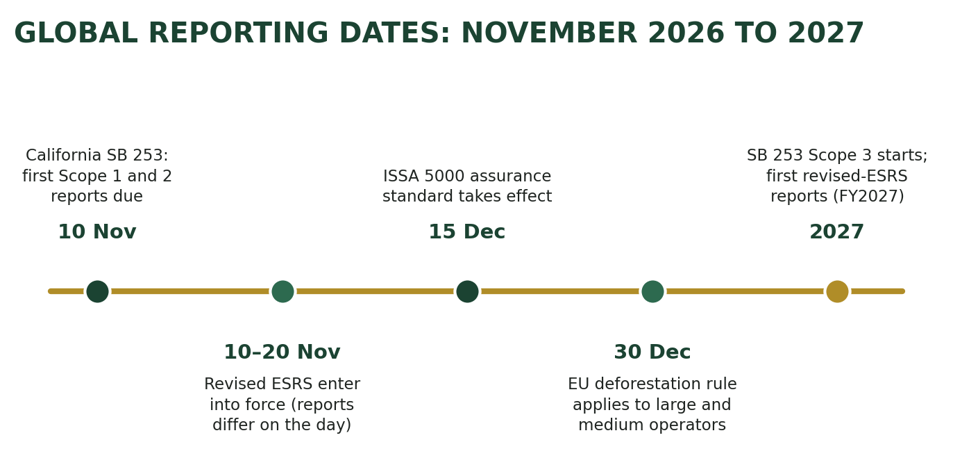
Second, the revised European Sustainability Reporting Standards, which cut mandatory datapoints by more than 60 percent and total datapoints by more than 70 percent, take effect around 10 to 20 November, depending on the source. They apply mandatorily from financial year 2027, and companies reporting for 2026 have three routes: keep the existing standards, adopt the revised ones early, or take selected reliefs.
Third, 15 December. ISSA 5000, the global sustainability assurance standard, becomes effective. CARB lists it among the standards it will accept for engagements beginning on or after that date.
Fourth, 30 December. The EU deforestation regulation applies to large and medium operators. Micro and small enterprises outside the earlier timber rules have until 30 June 2027.
Fifth, 2027. SB 253 brings in Scope 3, the emissions across a company’s supply chain. CARB is considering a phase-in beginning with five categories, the first being purchased goods and services. That proposal is not final, but its logic is clear: a brand’s own purchases include products made by its suppliers.
For suppliers, this is the point. When brands must report more, they ask more: energy use, emissions, materials, origin. Factories that can answer with consistent, documented data will be easier partners. Those that cannot will see their answers pieced together from estimates.
Every one of these dates will touch a customer of yours sooner or later. Suppliers who hold consistent, documented data will be the easiest to work with when the requests arrive.
Energy ESG Reporting
 ESG Frameworks
Hivedemy turns ESG into short, hands-on lessons built and checked by professionals worldwide. Every lesson teaches first, then asks you to do the work, and every attempt gets a reason.