
 Governance
Global Financial Integrity estimates Bangladesh recorded $68.3 billion in trade-related illicit flows over 2013 to 2022, about $6.83 billion a year. Bangladesh's financial intelligence unit is now building a shared price-verification database with banks and agencies. A database flags a suspicious invoice only when trained people know how to read it.

Some of the biggest leaks in an economy do not look like crime. They look like invoices.
Bangladesh recorded $68.3 billion in trade-related illicit financial flows between 2013 and 2022. That is about $6.83 billion a year, equal to roughly 16 percent of the country’s total trade, and the report puts Bangladesh among the ten most affected developing economies in Asia. About $32.8 billion of the total was linked to advanced economies.
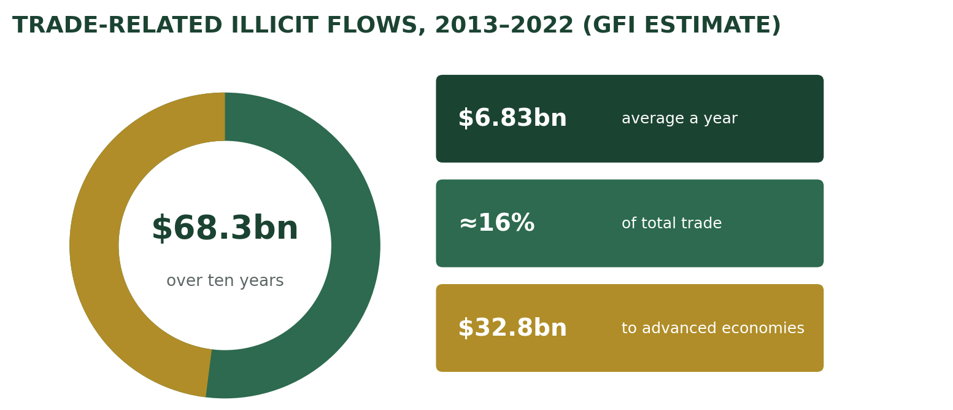
Global Financial Integrity’s estimate of trade-related illicit financial flows. It is an estimate, mainly of trade misinvoicing, not a count of proven money-laundering cases.
The mechanism is trade mis invoicing: falsifying the declared price or quantity of imports and exports. One tactic highlighted is over-invoicing imports of capital machinery, which can be used to move out money obtained through subsidized loans. The figure is an estimate of illicit flows, mainly mis invoicing, rather than a count of proven laundering cases. GFI warns that such flows weaken tax revenue and constrain funding for public services and infrastructure.
Bangladesh Financial Intelligence Unit together with representatives of Bangladesh Bank, the National Board of Revenue, law enforcement agencies, the Anti-Corruption Commission, the CID, customs intelligence and 15 scheduled banks with high trade volumes. Participants agreed to build a unified price-verification framework and a common database under a public-private partnership. Banks and authorities will compare declared import and export prices against a common reference and flag suspicious transactions for further checks. Significant price discrepancies will trigger additional verification, and a steering committee will oversee the effort.
An earlier study by the Bangladesh Institute of Bank Management shows the scale of the capability gap. In a survey of 37 banks, all said they had sanction screening, but only half subscribed to price-verification tools, and just 40 percent had centralised price-verification units. It also reported that the National Board of Revenue believes nearly 75 percent of domestic money laundering happens through trade channels.
A database does not catch a false invoice by itself. Someone must set the thresholds, understand how real prices vary, challenge unusual deals and document the decision. That is a governance skill as much as a technical one.
A shared database is only as good as the people who read it. Banks, customs officials and compliance teams that learn to tell a fair invoice from a manipulated one will make the new system work.
Governance Governance
 Governance
Hivedemy turns ESG into short, hands-on lessons built and checked by professionals worldwide. Every lesson teaches first, then asks you to do the work, and every attempt gets a reason.