Milestones from the central bank, the FRC and BSEC
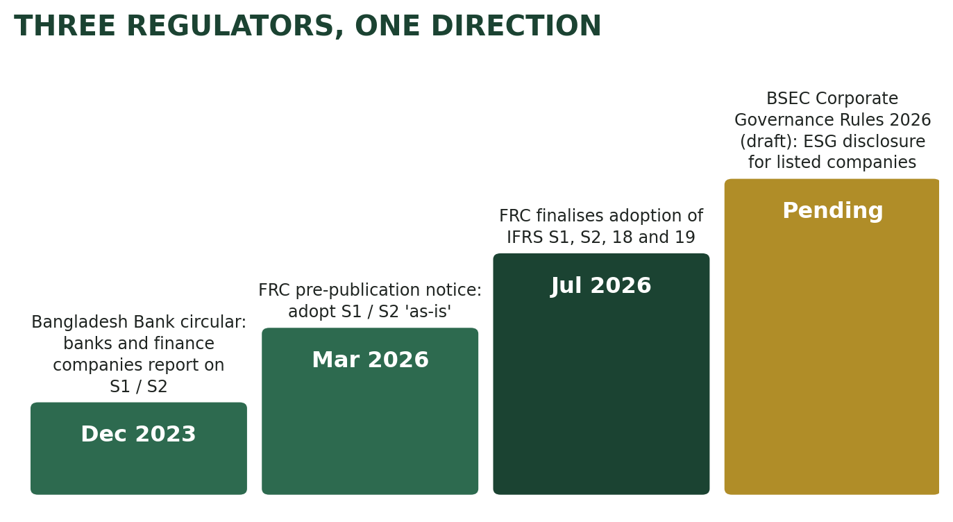
Quietly, in July, the rulebook for sustainability reporting in Bangladesh changed. The Financial Reporting Council (FRC) issued a circular finalising adoption of IFRS S1 and IFRS S2, the global standards for general sustainability disclosures and climate-related disclosures. It adopted IFRS 18 and IFRS 19, on financial statements, in the same move.
It did not come out of nowhere. Bangladesh Bank issued its own circular on 26 December 2023, asking banks and finance companies to report sustainability information based on S1 and S2. In March 2026 the FRC published a pre-publication notice saying it would adopt the standards as they stand, without local rewrites. A parallel consultation, reported by XBRL International, pointed toward extending the requirements to all listed companies, with digital XBRL reporting also on the agenda.
A second track runs through the capital market regulator. BSEC has put its Corporate Governance Rules 2026 out for public comment. Under the draft, listed companies would have to disclose ESG information in their annual reports, with the audit committee taking responsibility and an independent director in the chair. Boards would carry five to twenty directors, at least one woman and at least three independent directors or one-third of the board. A new Risk Management Committee would watch enterprise-wide risk. On 25 July, ICSB was still running training on the proposed rules, and BSEC’s chairman said they would strengthen transparency and accountability.
Three regulators, three levers, one direction: the central bank for lenders, the FRC for the standards themselves, BSEC for the boardroom.
One honest caution. The reporting on exactly when listed companies must begin applying S1 and S2 is not fully clear. IAS Plus notes that IFRS accounting standards already apply to public-market entities, while describing the sustainability requirement for listed entities in more careful terms. Anyone planning should read the FRC circular itself and watch for application dates.
What the standards ask for is demanding. S1 requires disclosure of the sustainability-related risks and opportunities that could affect a company’s prospects. S2 adds specific climate disclosures. That is far from a glossy CSR brochure. It needs data systems, governance trails, and people who can speak finance and sustainability in the same sentence.
Good rules without strict enforcement can slide into box-ticking. The sharper danger may be quieter still: a company that wants to comply but has no one who knows how.
The standards are set. For every CFO, audit committee chair and sustainability lead, the priority now is identifying who in their organisation can actually produce this report.