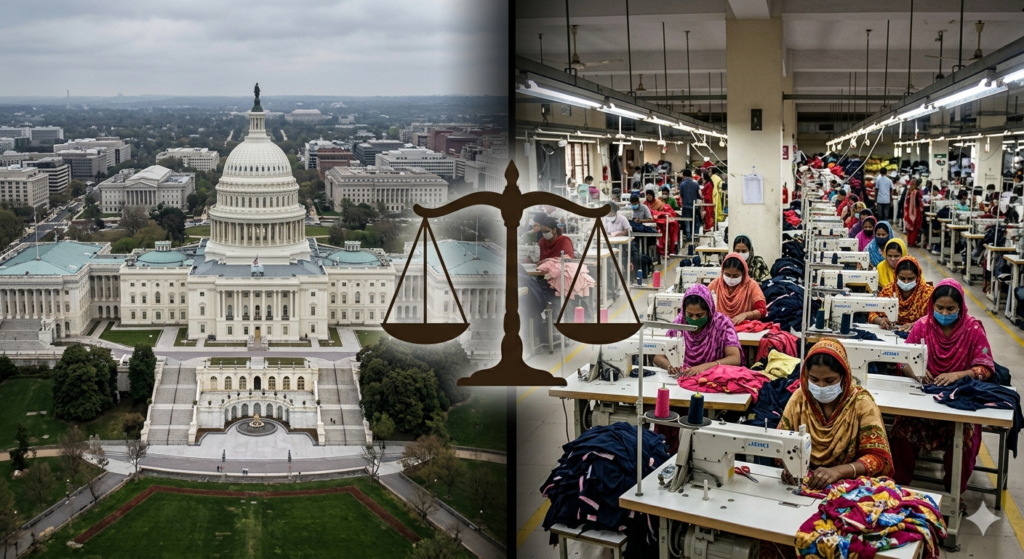
The United States has launched a Section 301 investigation into Bangladesh’s trade practices, focusing on export subsidies and alleged overcapacity. Public hearings are scheduled to begin in Washington on May 5, 2026, with a written submission deadline falling in mid-April — meaning Bangladesh’s government and industry associations have days, not weeks, to organise a credible response.
The Daily Star’s analysis of the situation is direct: relying on friendly diplomatic conversations or arguing that the US is being unfair will not work. Bangladesh needs to show up with hard data and a clear strategy. The article specifically points to the need for Bangladeshi diplomats to engage with American CEOs and coordinate with major US clothing brands — the buyers who depend on Bangladesh and who have the most direct relationship with the US market.
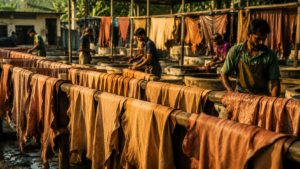
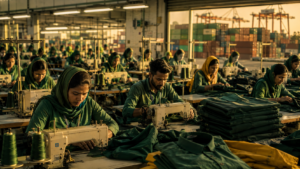
The trade stakes are real. The US is Bangladesh’s largest single export market. RMG accounts for over 80% of Bangladesh’s total exports, employing roughly 4 million workers — predominantly women. A tariff escalation, market access restriction, or reputational damage from a Section 301 finding could trigger a contraction that no domestic policy measure could quickly offset.
The ESG Dimension No One Is Talking About
Section 301 investigations focus on trade practices — but the underlying anxiety they express is about trust and transparency. Is Bangladesh a reliable, responsible, rules-compliant sourcing partner? That question is being asked simultaneously by the US government, by European regulators implementing CSRD and CS3D, by buyers with net-zero supply chain commitments, and by investors allocating to ESG-screened portfolios.
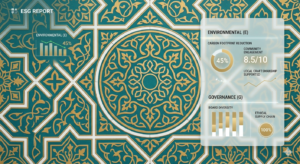
The answer to all of these questions is the same: verifiable ESG data. Labour rights compliance documented through credible social audits. Environmental performance measured and disclosed under GRI or IFRS S1/S2 frameworks. Governance standards demonstrated through transparent corporate disclosures. These are not separate from the trade argument — they are the trade argument, made in a language that international buyers, regulators, and trade officials understand.
Bangladesh currently cannot make this argument at scale. The Dhaka Stock Exchange has one of the lowest environmental disclosure rates in South Asia. Only 11 companies produce GRI-compliant sustainability reports. Most factories have no Scope 1 or Scope 2 emissions data. When a US trade official or an EU due diligence officer asks for evidence of responsible practice, the supply chain largely cannot produce it.
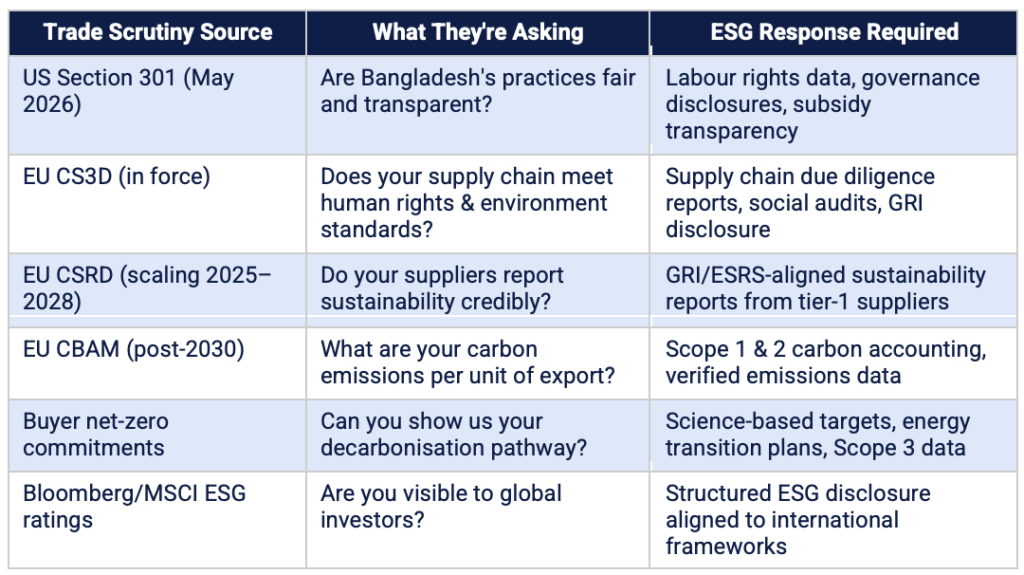
Figure 3: Every major trade and investment scrutiny mechanism demands the same thing — verifiable ESG data Bangladesh currently cannot produce at scale
The Strategic Window
Bangladesh has a narrow window before the May 5 hearings and the broader post-LDC graduation trade environment reshapes its market access fundamentally. In that window, the most durable competitive asset Bangladesh can build is not a diplomatic concession or a tariff negotiation — it is a verifiable track record of responsible practice.
Companies that invest now in credible sustainability reporting, third-party audited labour and environmental data, and internationally recognised ESG credentials are not just doing the right thing. They are building the documentation that governments, buyers, and investors will demand as the price of market access from 2026 onward. The professionals who can produce, verify, and communicate that documentation are among the most strategically important people in Bangladesh’s economy right now.
The US investigation is one symptom of a larger shift: the era of Bangladesh being assumed to be a responsible supplier based on price competitiveness and LDC goodwill is ending. The era of Bangladesh having to prove it — with data — has begun.
ESG Institute Bangladesh is Bangladesh’s only dedicated ESG education and advisory institute. We offer professional certification, corporate training, and sustainability reporting advisory built specifically for the Bangladesh context. The ESG Excellence Awards Bangladesh 2026 recognise organisations already building this future. Applications open now.
Professional Trainings (Diploma, Accreditations, In-Depth Workshops): https://esginstitutebd.com/| Join the 2026 ESG Awards: esgawardsbd.com