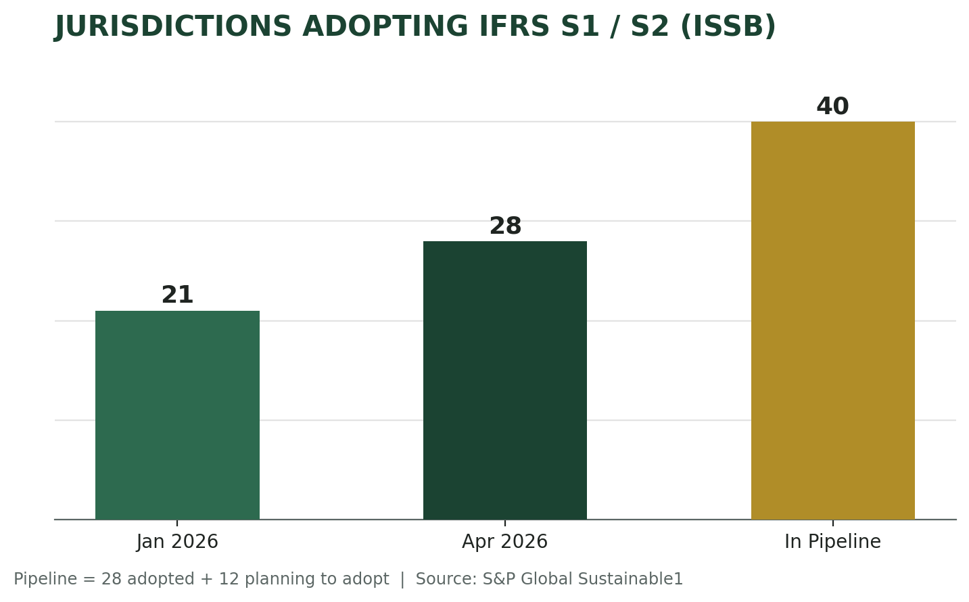
Adoption trend for the ISSB’s IFRS S1 (general sustainability disclosures) and IFRS S2 (climate disclosures), per S&P Global’s quarterly regulatory tracker. Bangladesh has launched a formal consultation on adoption.
While most of the world’s attention on sustainability regulation has been fixed on Europe’s rollbacks, a quieter and arguably more consequential shift has been building elsewhere: a genuine global baseline for sustainability disclosure is taking shape, and it’s moving faster than almost anyone predicted.
The International Sustainability Standards Board’s IFRS S1 and S2 — covering general sustainability-related disclosures and climate-specific reporting, respectively — have now been adopted on a voluntary or mandatory basis in 28 jurisdictions as of late April 2026, up from 21 at the start of the year. Another 12 jurisdictions are actively working toward adoption. Collectively, the countries moving toward these standards represent more than 60% of global GDP, according to the ISSB’s own chair.
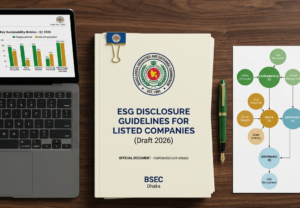
Bangladesh is one of the jurisdictions now in that pipeline. A formal consultation has been launched on adopting IFRS S1 and S2 as part of the country’s push to modernise its sustainability disclosure framework — placing it alongside a wave of emerging and advanced economies making the same move in real time.
The regional context makes the pace clear. South Korea’s securities regulator issued two ISSB-aligned disclosure standards in the first quarter of 2026 alone. The UK published its own UK-specific standards based on IFRS S1 and S2 in February, with its financial regulator moving to make climate disclosure mandatory for listed companies from January 2027. Japan has gone further still, mandating disclosures for listed companies and building jurisdiction-specific alternatives — including a requirement to disclose disaggregated Scope 3 emissions across 15 supply-chain categories, a level of granularity even the base ISSB standard doesn’t demand outright.
Why does any of this matter to a company in Dhaka or Chattogram that doesn’t sell directly into these markets? Because ISSB adoption isn’t happening in isolation — it’s converging with the EU’s own reporting framework, with regulators explicitly working to align the two, and it’s increasingly what international investors, lenders and buyers use as their default expectation for credible sustainability data, regardless of where a supplier is based. A Bangladeshi exporter, bank, or listed company that can already report against IFRS S1/S2-aligned metrics won’t just be compliance-ready when Bangladesh formalises adoption — it will be several steps ahead of competitors scrambling to catch up once the consultation closes and a mandate lands.
The standards themselves are demanding: companies must disclose sustainability-related risks and opportunities that could reasonably affect their cash flows and access to finance, alongside specific climate metrics like greenhouse gas emissions and scenario-based analysis of physical and transition risks. That’s a meaningfully different skill set than the CSR-style reporting many companies in Bangladesh have relied on to date — and building it takes lead time that the consultation period, however long it runs, will not extend indefinitely.