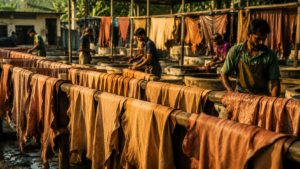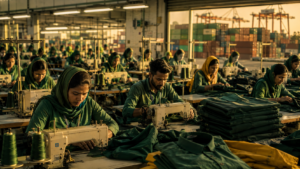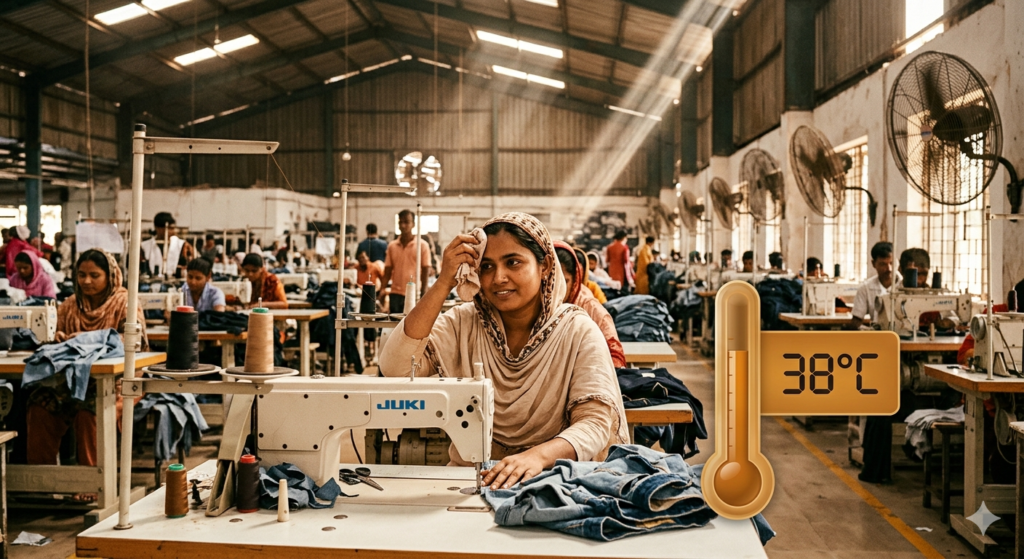
‘My Body Is Burning.’ That is the title of Climate Rights International’s January 2026 report on extreme heat and labour rights in Bangladesh’s garment factories — and it is not metaphor. It is a direct quote from workers interviewed across Dhaka’s manufacturing districts, where factory temperatures routinely exceed safe working limits during summer months with inadequate ventilation and no legally mandated cooling standards.
The data from the report is stark. A worker named Aarit, in Mirpur, described output falling from 60 pieces ironed per hour to 50 on the hottest days. That is a 17% productivity collapse. Another worker, Kaavi, reported extending shifts by 50% in the hot season just to meet the same targets. Workers described dehydration, dizziness, nausea, blurred vision, and fainting as common experiences — not exceptional incidents. These are the conditions under which Bangladesh’s $47 billion garment export sector operates every summer.
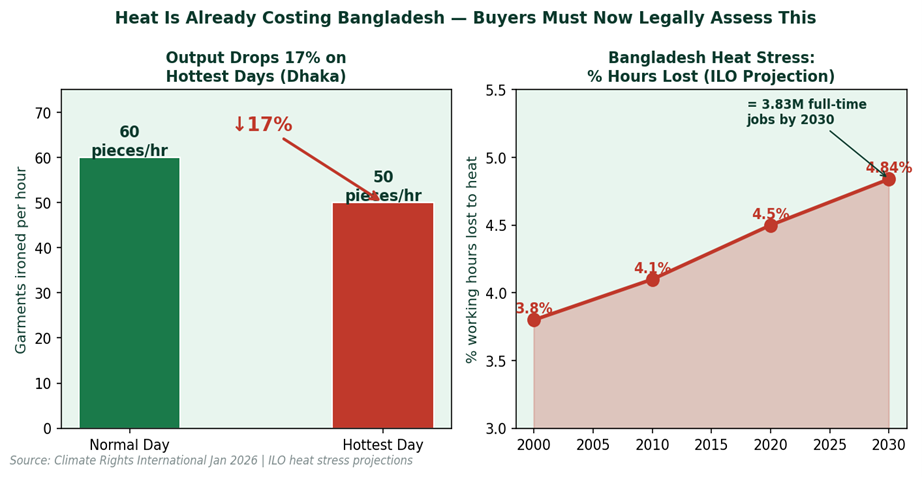
Left: garment worker output drops 17% on hottest days in Dhaka factories (CRI Jan 2026). Right: Bangladesh projected working hours lost to heat — rising from 4.24% in 1995 to 4.84% by 2030, equal to 3.83 million jobs (ILO)
ILO: Bangladesh will lose 4.84% of total working hours to heat stress by 2030 — equivalent to 3.83 million full-time jobs. This is already happening.
Climate Rights International conducted its research across garment, construction, and transport workers in Dhaka and Karachi — naming the Bangladeshi factories producing for major international brands. The report was cited by The Business of Fashion, The Guardian, and across international sustainability media in the weeks that followed. The ESG teams at H&M, Primark, Zara, and Gap are reading it. Their sourcing decisions are influenced by it.
Here is where this crosses from worker welfare into trade compliance: the EU’s Corporate Sustainability Due Diligence Directive, coming into force in 2029, requires in-scope European brands to identify, assess, and address adverse environmental and human rights impacts across their entire supply chains. Occupational heat stress — which threatens worker health, reduces productivity, and constitutes an occupational safety violation under ILO standards — is explicitly within the scope of CSDDD’s human rights due diligence obligations.
This means European buyers now have a legal incentive to ask Bangladeshi suppliers documented questions: What is your factory’s average temperature during summer months? What cooling infrastructure exists? What is your worker heat illness incident rate? What adaptation investments have you made? Factories that cannot answer these questions with documented evidence face a compliance risk that translates directly into order risk.
Bangladesh’s climate position compounds this. The country ranks among the top 10 globally for climate vulnerability. Rising temperatures are not cyclical — every year will be warmer than the last. Factories that treat heat adaptation as optional will face compounding productivity losses, higher worker turnover, increased healthcare costs, and eventually buyers who source from competitors with better climate worker protections.
The documented policies, temperature monitoring systems, worker health protocols, and incident reporting structures that turn concern into compliance. The heat is here. The legal requirement is arriving. The window to build the framework proactively, before the first order cancellation, is now.