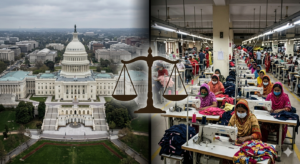
Bangladesh Gave Environment Less Than 0.3% of Its Budget — While Ranking 13th in Global Climate Risk

The Ministry of Environment received just 0.27% of Bangladesh's national budget in FY2025-26. Policy analysts say it needs roughly 1%. This gap between climate rhetoric and climate spending is the governance failure Bangladesh cannot afford.

Share On:

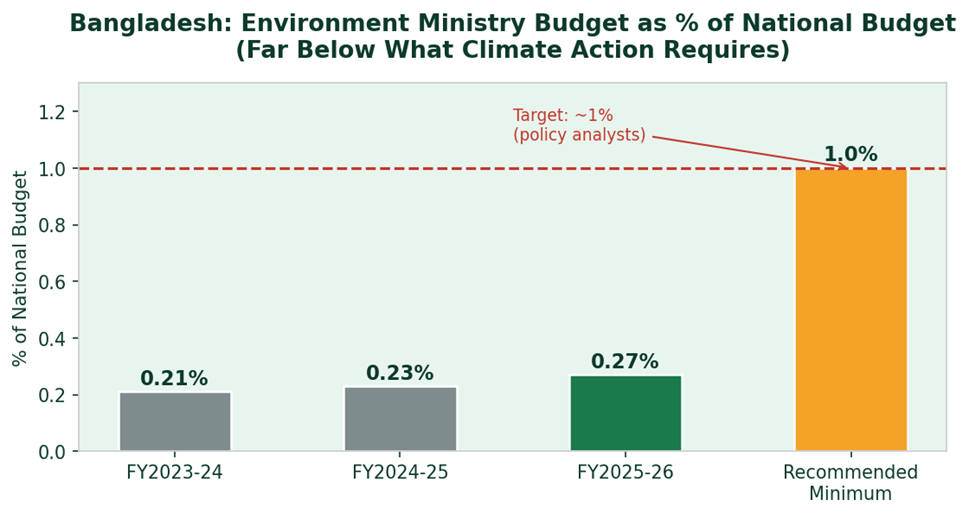
📊 Bangladesh Environment Ministry budget as % of national spend — far below the ~1% minimum policy analysts recommend

Bangladesh ranks 13th in the world on the Long-Term Climate Risk Index. Over the past two decades, 185 extreme weather events have caused 11,450 deaths and Tk 372 crore in economic losses. The country loses approximately 0.4% of GDP annually to heat stress alone. It is one of the most climate-exposed nations on earth.

In FY2025–26, the Ministry of Environment, Forest and Climate Change received 0.27% of the national budget.

Policy analysts say it should be around 1%. The gap between those two numbers — 0.27% and 1.00% — is the gap between what Bangladesh says about climate change and what it actually funds.

This is a governance problem. And governance is the ‘G’ in ESG.

The analysis is sobering. In the previous fiscal year, FY2024–25, overall Annual Development Programme spending fell to just 68% of allocation — the lowest figure in 49 years. Development spending in the first half of FY2025–26 reached only 17.54% of the annual target. The institutions charged with implementing environmental policy are underfunded and under-executing simultaneously.

The previous interim government, which held power from August 2024 to February 2026, struggled to maintain the policy momentum built up over decades of environmental governance development. Now, with an elected government in place, there is an opportunity to reset — but the institutional and financial gaps are real and deep.

The new government’s election manifesto includes commitments to tree planting, waste management, and river restoration. These are welcome. But they are individual actions, not a governance framework. Planting trees without enforcement capacity, water management without cross-ministry coordination, and climate finance without absorption capacity will not shift Bangladesh’s trajectory.

What would a genuine commitment to environmental governance look like? Three things, primarily.

First, budget: the Environment Ministry needs to receive meaningfully more than 0.27% of national expenditure. Reaching 0.5% in the next budget would be a signal. Reaching 1% within three years would be transformative.

Second, coordination: the climate agenda sits across the Ministry of Environment, the Ministry of Finance (climate finance), the Ministry of Power (energy transition), the Ministry of Commerce (trade compliance), and the Bangladesh Bank (sustainable finance). None of these are talking to each other systematically. A national ESG and climate coordination mechanism — potentially housed in the Chief Adviser’s Office — is overdue.

Third, institutions: regulatory bodies like the Department of Environment need sufficient staff, independent authority, and real enforcement capacity. Environmental violations need to carry meaningful consequences.

For the private sector, this matters directly. A country with weak environmental governance creates uneven competitive conditions — companies that cut compliance corners gain short-term advantage over those that invest in ESG. Without government enforcement, voluntary ESG commitment is undercut by free-riders.

Bangladesh is asking international investors and buyers to trust that it can manage a $26 billion annual climate finance requirement, transition a grid away from fossil fuels, and qualify for EU GSP+ based on environmental compliance.

That trust starts with the budget. 0.27% says something. Make it say something different.

Meet the Author

Share On:

Being read right now

Bangladesh Signed a Trade Deal with Japan. Labour Rights and Environmental Accountability Are in the Text

On February 6, Bangladesh signed its first-ever Economic Partnership Agreement with Japan. The headline: duty-free access to 97% of Bangladesh's export basket, including RMG. What the headlines missed: the EPA contains specific provisions on labour rights, fair wages, safe work environments, social security, pollution control, natural resource conservation, and sustainable development. This is not just a trade deal. It is ESG compliance embedded in bilateral law.

COP 29 in 2024: Takeaways and how it impacts Bangladesh

COP 29 in Baku marked a significant milestone in global climate action, with participation from the ESG Institute Bangladesh. This conference addressed pressing climate challenges, setting the direction for future policies and enhancing cooperation among nations. Our institute’s takeaways highlight the importance of international carbon markets, climate finance, transparency, support for vulnerable communities, and the […]

Bangladesh Exported $3.14 Billion in Garments Last Month. Now Read What That Number Is Hiding.

Bangladesh RMG exports: $3.14 billion in April 2026 — up 31.21% year-on-year. Knitwear: +30.02%. Woven: +32.65%. Technically accurate. Also deeply misleading. April 2025 was one of the worst export months in recent history: Eid shutdown, India's transshipment ban, and US tariff shock all hit simultaneously. The 31% is measured against a collapsed floor. This is a live example of exactly what ISSB disclosure standards exist to prevent: data without context.

15% of the Sundarbans Can’t Recover from Climate Stress, but Bangladesh Ignores the Emergency

A peer-reviewed study published in Communications Earth & Environment analysed 25 years of satellite data and found that 10–15% of the Sundarbans 610 to 990 square kilometres has lost its ability to recover from environmental stress. Cyclones, saline intrusion, and human pressure are driving what scientists call 'critical slowing down.' The forest that protects 6 million people, sequesters millions of tonnes of carbon, and sustains Bangladesh's coastal economy is weakening and the governance response has not matched the scientific urgency

At ESG Institute Bangladesh, learn from global and local experts in sustainable development and join a community of professionals committed to making lasting change.

ESG Corporate Workshops

Expert learning on fundamentals of ESG and Sustainability for Corporates.
Learn more

ESG Student

Workshops

University sessions by corporate, policy and development sustainability experts on SDGs, Careers and Sustainability.
Learn more

ESG & Sustainability

Corporate Training

Curated, certified training on key SDG, ESG, Sustainability and Compliance experts from around the globe designed to build professional expertise.
Learn more

ESG-Sustainability

Professional Certifications

Build your professional career in ESG & Sustainability from globally recognized certifications and accreditions.
Learn more

ESG Professional Bootcamp

Learn from ESG-Sustainability experts and network with professionals in the industry in an engaging, 2-day Bootcamp centered on intensive learning on ESG and Sustainability for corporates.
Learn more

Contact Us

Contact the ESG Institute Bangladesh below, or send your contact information to request a callback from our representative.

Address

6th Floor, BIMS Bhaban, GA-9/3, Progoti Sharani, Dhaka-1212

Email

info@esginstitutebd.com

Call Us

+8801626658248