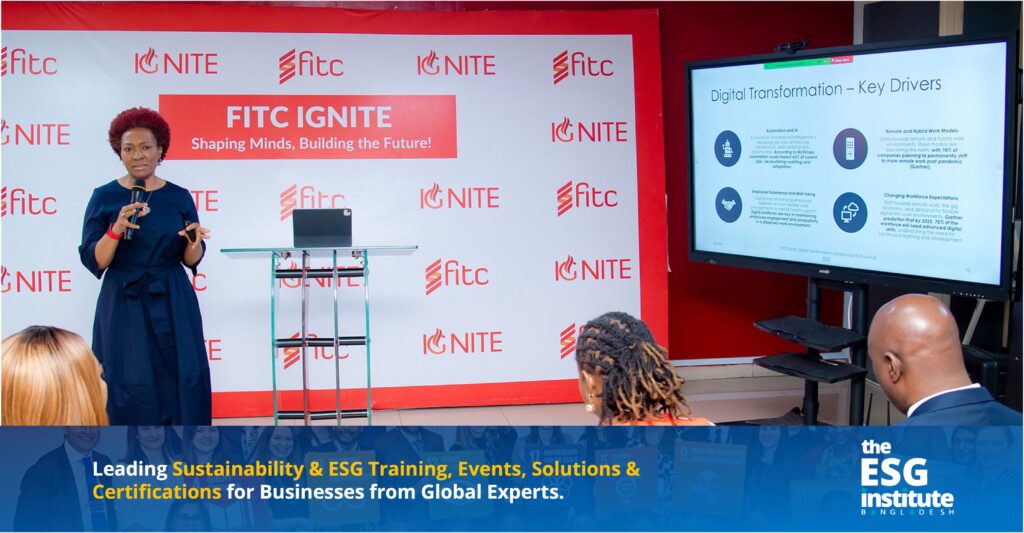
The newly established Sustainability & ESG institute aims to become a hub for industry leaders, academics, policymakers, and change-makers to collaborate on sustainable practices.
Chizor Malize, MD/CEO of FITC, emphasized the growing global awareness of ESG issues and the urgent need for organizations to adopt sustainable strategies. She highlighted that the Institute will empower organizations to integrate ESG principles through cutting-edge research, comprehensive training programs, and impactful initiatives, ensuring long-term value creation for stakeholders. Malize also acknowledged the contributions of the FITC Board and Advisory Board members in shaping the Institute’s strategies, emphasizing that its success will be measured by tangible impact and strong partnerships.
In his keynote address, Philip Ikeazor, Deputy Governor of Financial Systems Stability at the Central Bank of Nigeria (CBN) and Board Chairman of FITC, underscored the summit’s focus on advancing ESG practices. Delivered by Nwabueze Orjiakor, the address highlighted the urgent need for robust ESG practices in response to global climate challenges, emphasizing the critical role of ESG in fostering business resilience, value creation, and economic stability.
Professor Fabian Ajogwu, Senior Partner at Kenna Partners, stressed the importance of governance in ESG, advocating for the integration of ESG discussions into board meetings and strategic planning. He noted the significance of considering regional contexts in implementing governance practices for sustainable outcomes.
Oluwasoromidayo George, Corporate Affairs and Sustainability Director at Coca-Cola HBC, highlighted the importance of social impact within ESG. With over 20 years of experience, George emphasized that corporate initiatives should aim to improve society for everyone.
Andrey Bogdanov, CEO of Risk Insights, shared insights into the role of machine learning and artificial intelligence (AI) in advancing ESG initiatives. His presentation showcased the innovative ESG tool, “Built for Africa by Africans,” underscoring the need for localized and tailored solutions to achieve sustainability goals.
The FITC Sustainability and ESG Institute aims to shape the future of organizations and contribute to building a more sustainable, equitable, and prosperous world through collaboration and innovation.