Bangladesh’s garment industry has built its global reputation on scale and speed. Its next competitive test will be measured in a different currency: gigawatts, energy audits, and greenhouse gas ledgers.
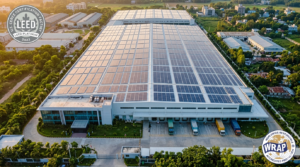
A recent analysis puts a concrete price tag on what the industry has long discussed only in the abstract. To cut sector-wide greenhouse gas emissions by 50% by 2030, Bangladesh’s ready-made garment sector needs roughly $6.6 billion in investment — about $1.29 billion every year — directed primarily at renewable energy installations and energy-efficiency upgrades across factories.

The pressure behind that number isn’t coming from any single direction. Energy costs are climbing. Dependence on imported fuel is creating macroeconomic strain that ripples down to factory floors. Global buyers are tightening their sustainability expectations well beyond what a compliance certificate used to cover. And export markets themselves are shifting toward more demanding disclosure and reporting regimes — the kind that require factories to actually know, and prove, their emissions numbers rather than estimate them.
What makes this moment different is that the industry itself is now framing the green transition not as an environmental checkbox, but as a strategic business necessity. That reframing surfaced clearly at a recent Access to Finance Roundtable convened in Dhaka, which brought together government officials, development finance institutions, commercial banks, industry leaders, and development partners around a single, uncomfortable question: why does green finance remain insufficient despite such obvious and growing demand for industrial decarbonisation?
Part of the answer is structural. Banks and development finance institutions want bankable, well-documented projects — energy audits, verified emissions baselines, credible efficiency plans. Many factories, especially small and mid-sized ones, don’t yet have the in-house expertise to produce that documentation to the standard financiers expect. The result is a financing gap that isn’t really about a shortage of capital — it’s about a shortage of investment-ready proposals.
The upside is real, and it isn’t purely environmental. Aligning green finance with industrial competitiveness could reduce the sector’s exposure to volatile energy prices, strengthen its resilience against future compliance shocks, and help it remain competitive as global apparel markets increasingly reward — and eventually require — credible sustainability performance over sheer production volume.
For a sector that accounts for the overwhelming majority of Bangladesh’s export earnings, the next few years will likely determine whether “green transition” becomes a genuine competitive advantage or a missed deadline the industry keeps discussing at roundtables instead of solving. The $6.6 billion question isn’t really whether the money exists somewhere in the system. It’s whether enough factories, banks, and policymakers can speak the same technical language — emissions baselines, energy audits, verified reporting — quickly enough to put it to work.