H1 2026 Shipbreaking Safety Snapshot
| ~80% Of accidents caused by falling objects, crane/wire failures, or gas & fire | 21 / 28 Accidents occurred during daytime shifts |
| 25 Yards Now hold international green-yard certification (ClassNK, ClassIR, Bureau Veritas) | April Month with the highest number of recorded incidents |
The numbers landed hard at a labour research conference in Chattogram. In the first half of 2026, three workers were killed and 25 others injured across 28 separate accidents in Bangladesh’s shipbreaking industry — compared with one death and 16 injuries across 15 accidents during the same period last year, according to a report released by the Bangladesh Institute of Labour Studies (BILS).
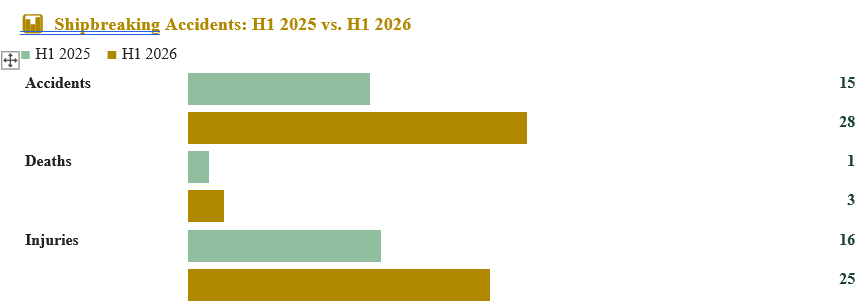
Behind those totals sits a more specific picture. Ten of the injured workers suffered serious harm, 15 moderate. Most accidents — 21 of 28 — happened during daytime shifts, with April recording the highest number of incidents in the six-month window. Falling girders and other heavy objects, crane, hook and wire-related failures, and gas and fire incidents together accounted for nearly 80% of all reported accidents. The workers most exposed weren’t senior engineers or supervisors — they were cutters, cutter helpers, crane helpers, wire group workers, fittermen and loading crews: the hands-on roles closest to the heaviest, most volatile parts of dismantling a ship.
BILS didn’t stop at counting incidents. Its report traced the accidents back to a familiar, almost entirely preventable set of root causes: unsafe work practices, hazardous working conditions, inadequate use of personal protective equipment, weak supervision, and insufficient safety training. None of those require new technology to fix. They require consistent enforcement of standards that already exist.
The report’s recommendations read like a checklist rather than a wish list: implement Hong Kong Convention and ILO safety guidelines, enforce mandatory PPE use, run proper gas testing before cutting begins, adopt permit-to-work systems, ensure safe crane operations, hold regular toolbox safety meetings and emergency drills, and invest in ongoing safety training rather than one-off inductions. It also called for stronger enforcement of existing labour laws and thorough investigation of every workplace accident — not just the fatal ones.
Here’s the part that should reframe how this story gets told: this isn’t a story about an industry that can’t be made safe. Separately, Bangladesh’s Ship Recycling Board has confirmed that 25 shipbreaking yards in Chattogram have now earned international green-yard certification from bodies including ClassNK, ClassIR and Bureau Veritas — independent proof that safer, cleaner, internationally compliant operations are achievable at scale, not just in theory.
That’s the uncomfortable contrast sitting at the heart of this data: a widening gap between yards that have invested in certified safety systems and the wider industry average, where accidents are rising rather than falling. As officials at the report’s launch put it, every workplace accident in this industry is preventable — which means every one that still happens is also, in a very direct sense, a choice about how much a yard has invested in getting its workers home safely. For an industry central to Bangladesh’s industrialisation, closing that gap isn’t optional risk management. It’s the difference between an internationally respected recycling sector and one that keeps making headlines for the wrong reasons.