
 ESG News
The Dhaka Chamber of Commerce and Industry (DCCI) President Ashraf Ahmed emphasizes that adopting ESG compliance reporting is crucial for enhancing trade and investment.

DCCI President Ashraf Ahmed emphasized that adopting an ESG compliance framework is essential for aligning business values with sustainability, fostering economic growth, and remaining competitive post-LDC graduation. He highlighted challenges such as weak corporate governance and lack of data in Bangladeshi industries during a round table discussion on ESG compliance.
“Absence of culture, weak corporate governance and lack of data are few of the challenges to adopt ESG in Bangladeshi Industries,” Ashraf said this in a round table discussion titled “Navigating the Challenges and Opportunities of ESG Compliance in Bangladesh” organized by DCCI today.
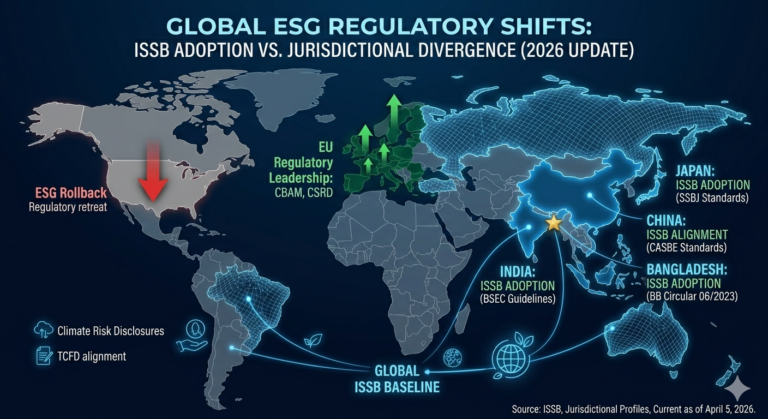
As Bangladesh’s international trade grows, ESG compliance is becoming mandatory. Investors view ESG factors as indicators of resilience and long-term financial health. The trend of ESG reporting is rising in Bangladesh, with both organizations and government bodies taking initiatives to promote it.
Ashraf recommended developing effective ESG compliance strategies aligned with the global value chain and integrating ESG into decision-making and organizational culture. He also stressed the importance of educating stakeholders about ESG compliance and embedding it in policies like industrial and SME policies.
Md. Munim Hassan, Director General, Department of Patent, Design & Trademarks, Ministry of Industries, emphasized the necessity of compliance in all sectors to enhance business credibility. “For environmental or social compliance, we individually should take responsibility on our shoulder. We should not look into what others do,” he added. He noted that from 2016 to 2022, 17 Bangladeshi products received GI certification, with 30 more in progress since 2023.
Md. Anwarul Alam, Director General (Additional Secretary), Bangladesh Accreditation Board (BAB), highlighted BAB’s role in ESG, ensuring quality goods and services with globally accepted certification. He urged compliance and lab accreditation from BAB. “ESG is also interlinked with the vision of Smart Bangladesh,” he said.
Keynote speaker Zaku Uz Zaman, Country Representative, UNIDO, Bangladesh, explained ESG’s origins and its role in evaluating a firm’s engagement with environmental, social, and governance factors. “Compliance with ESG reporting can help Bangladeshi companies to be competitive after graduation from LDCs,” he added.
Other speakers, including Dr. M Niaz Asadullah, Mohammad Bin Quasem, Yeasmin Akther, M Abu Horairah, Enamul Haque Patwary, and Rashid Shah Shamrat, stressed the need for an ESG policy, awareness, monitoring, and reporting systems. They emphasized environmental safety through afforestation and concerted efforts to implement ESG regulations.
ESG News Environment
 ESG Global Trends
Hivedemy turns ESG into short, hands-on lessons built and checked by professionals worldwide. Every lesson teaches first, then asks you to do the work, and every attempt gets a reason.