In 2025 and into 2026, the United States federal government has pursued one of the most aggressive rollbacks of ESG and climate policy in recent history. Biden-era executive orders on climate have been revoked. The SEC’s climate disclosure rule — which would have required publicly listed companies to report climate-related financial risks — has been deprioritised. Federal financial regulators have reversed or scaled back climate-related guidance. The phrase “ESG” has become politically toxic in Washington.
For observers outside the US watching this unfold, there is a tempting narrative: if the world’s largest economy is stepping back from ESG, perhaps the whole movement is losing momentum. Perhaps Bangladesh, which has its own enormous economic pressures, can take a breath and slow down its sustainability commitments.
That narrative is seductive. It is also exactly wrong — and for Bangladesh, following it would be commercially catastrophic.
Who Actually Buys Bangladesh’s Products
The United States is Bangladesh’s single largest country-level export destination. But the EU, taken as a bloc, is significantly larger. And it is the EU — not the US — that is driving the regulatory requirements that will define what Bangladesh must do over the next decade.
The EU has not retreated from ESG. Its Corporate Sustainability Reporting Directive, its Carbon Border Adjustment Mechanism, its supply chain due diligence laws — these are all in motion. Yes, there have been delays and simplifications under the so-called “Omnibus” reform package of 2025. CSRD reporting timelines have been pushed back slightly. But the direction has not changed. The EU’s destination is mandatory, standardised, third-party assured sustainability disclosure for all companies in its supply chains.
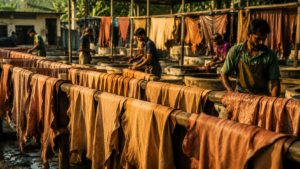
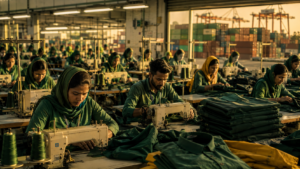
Bangladesh is in Europe’s supply chains. Our garments, our pharmaceuticals, our leather — all of it flows into a regulatory environment that is becoming more demanding, not less, regardless of what Washington does.
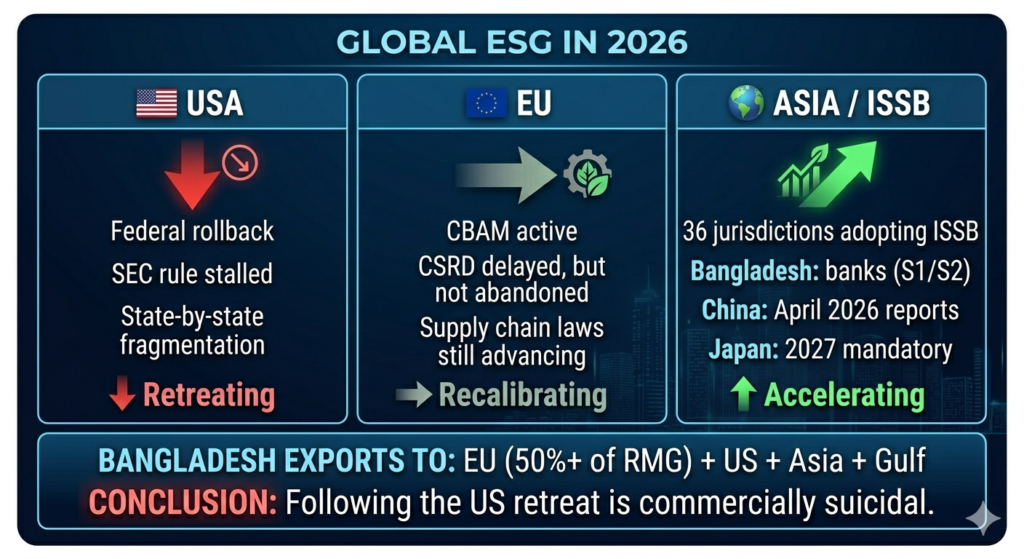
Diagram: The Three ESG Worlds in 2026
The ISSB Is Winning
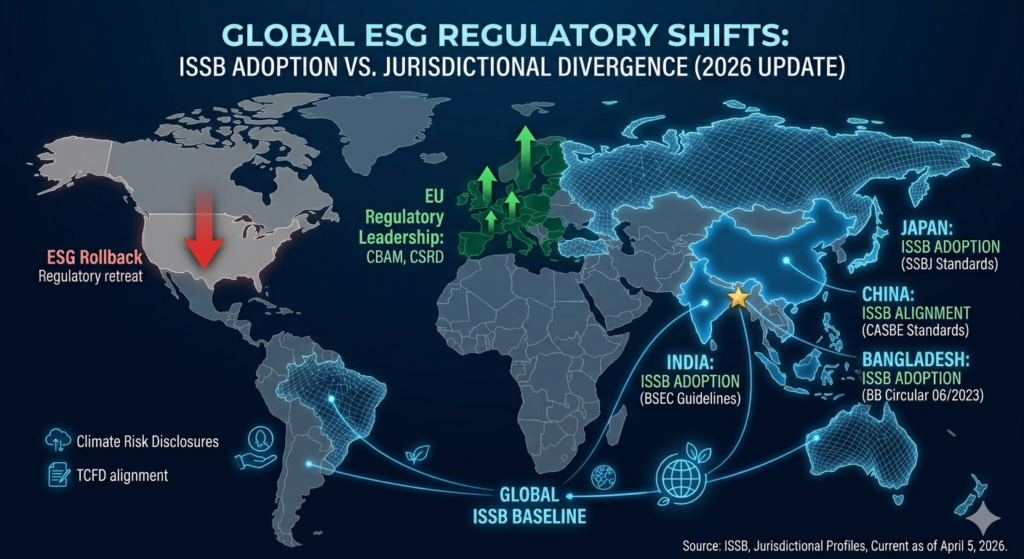
The more important story underneath the US political noise is the steady global march of the International Sustainability Standards Board. As of mid-2025, 36 jurisdictions had adopted or were actively moving to incorporate ISSB standards into their regulatory frameworks — covering nearly 60% of global GDP.
Bangladesh is on that list. Bangladesh Bank adopted IFRS S1 and S2 in December 2023. China’s stock exchanges are requiring ESG disclosure from listed companies by April 2026. Japan’s Tokyo Prime Market is moving to mandatory climate disclosure. Singapore and Hong Kong have mandated climate reporting. South Korea is considering due diligence legislation.
The US is the loud exception, not the rule. And even within the US, California — whose economy alone would rank among the world’s largest — has enacted mandatory GHG emissions reporting for companies with over $1 billion in revenue doing business there. Bangladeshi pharmaceutical and garment companies supplying US retailers that operate in California are functionally within scope.
The global baseline is not disappearing. It is consolidating everywhere except Washington.
What ESG Fragmentation Actually Creates for Bangladesh
The Freshfields 2026 ESG trends report puts it plainly: businesses operating globally face a fragmented regulatory landscape — US pulling back, EU tightening, Asia accelerating — and the winners will be organisations that can navigate multiple standards simultaneously rather than picking one and ignoring the rest.
For Bangladesh, this fragmentation is actually an argument for building ESG capability sooner, not later. Here is why:
Buyers increasingly embed ESG requirements in procurement contracts. H&M, Zara, Walmart, and their peers have corporate sustainability commitments that do not disappear because the US federal government has different politics. They will increasingly require their Bangladeshi suppliers to provide emissions data, labour disclosures, and sustainability reports — regardless of what is mandatory under Bangladeshi law.
Gulf and Asian investors are becoming more ESG-aware. Bangladesh’s growing relationships with Gulf sovereign wealth funds and regional development finance institutions are happening in a context where ESG credentials increasingly affect terms and eligibility.
Greenwashing risk cuts both ways. As ESG becomes a commercial expectation, companies that make sustainability claims without evidence face legal and reputational exposure. The answer is not to avoid ESG — it is to do it properly.
The Lesson From the Global Picture
When ESG is politically controversial in the US, the sophisticated response from emerging markets is not to retreat — it is to professionalise. To build internal capacity that can withstand scrutiny. To report against recognised frameworks rather than making unsubstantiated claims. To train the people who will do this work credibly.
The companies in Bangladesh that invest in ESG knowledge and reporting infrastructure now will be insulated from buyer pressure, better positioned for investment, and ahead of the regulatory curve when it tightens — as it will.
The companies that wait for political consensus from Washington will find that their EU buyers did not wait with them.
ESG Institute Bangladesh is Bangladesh’s only dedicated ESG education and advisory institute. We offer professional certification, corporate training, and sustainability reporting advisory built specifically for the Bangladesh context. The ESG Excellence Awards Bangladesh 2026 recognise organisations already building this future. Applications open now.
Professional Trainings (Diploma, Accreditations, In-Depth Workshops): https://esginstitutebd.com/| Join the 2026 ESG Awards: esgawardsbd.com