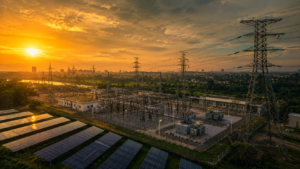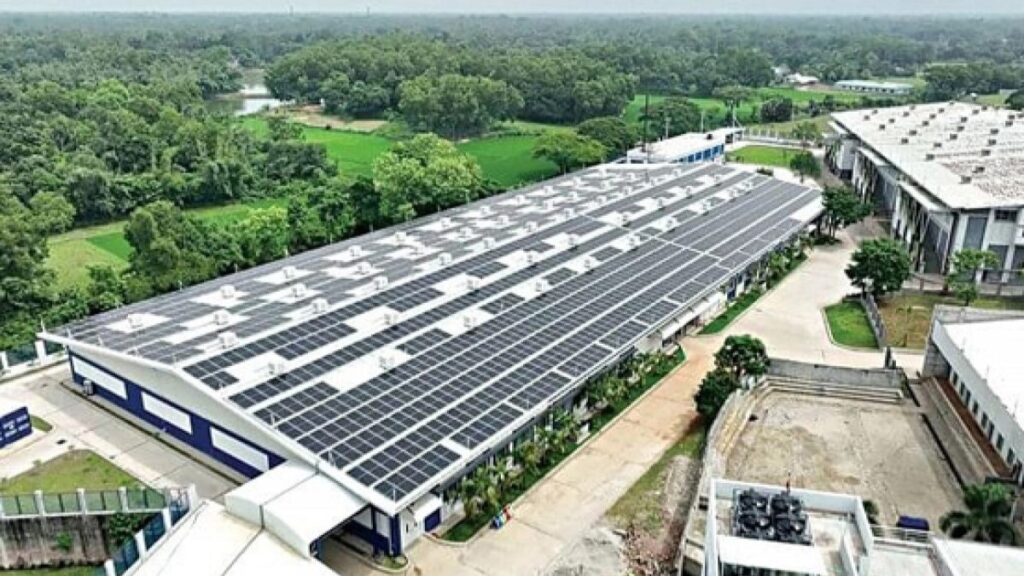
Data published alongside the Ember/V20 report in April 2026 confirms what early adopters in Bangladesh’s industrial sector have quietly known for two years: rooftop solar now generates electricity at a cost below grid rates for factories operating under net metering. The government’s recently relaxed net metering policy — removing the previous 70% transmission cap and allowing 100% of surplus power to flow back to the grid — makes the economics even more compelling for large industrial users.
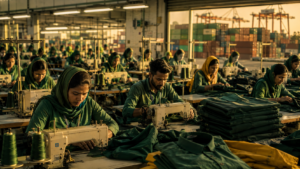
The industrial rooftop solar pipeline is described by IEEFA analysts as ‘increasingly promising,’ with more than 200 garment facilities already deploying systems under IFC’s Greener Garments Initiative. Bangladesh has over 7,000 RMG factories with vast rooftop space — IDCOL estimates 420 lakh square feet of textile factory rooftops alone can generate 400 MW. The opportunity at scale is enormous.
But there is a gap that the solar installers cannot fill. Once the panels go up and the meters start running, the next question from buyers, banks, and regulators is: how do you prove it? How do you quantify the Scope 2 emission reduction? How does it appear in your sustainability report? How is it verified?
The Reporting Gap
Sustainability reporting in Bangladesh remains deeply fragmented. The Dhaka Stock Exchange has one of the lowest environmental disclosure rates in South Asia. As of 2020, only 11 companies produced GRI-compliant sustainability reports — compared to 74 in India. Even among companies that do report, ESG disclosures often lack the rigour to be useful for investors, buyers, or ratings agencies.
This creates a specific problem for the energy transition. A factory that has installed 1.5 MW of rooftop solar — a genuine achievement, a real emission reduction — may derive almost no commercial benefit from it if the measurement, verification, and disclosure are not done correctly. Buyers with net-zero targets need data in formats they can aggregate. Investors need it in formats they can compare. Both require GRI-aligned or IFRS S1/S2-aligned reports prepared by people who understand what they are doing.
ESG DISCLOSURE: BANGLADESH VS REGIONAL PEERS (GRI-COMPLIANT REPORTS, 2020)

Figure 4: Bangladesh has the lowest GRI-compliant disclosure rate among major South Asian economies. Solar investments aren’t being captured
The Professional Opportunity
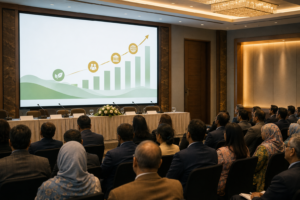
Every factory that installs solar needs someone who can translate kilowatt-hours into Scope 2 emission reductions, document the methodology, and incorporate it into a credible sustainability report. Every company that wants to present its energy transition progress to EU buyers, domestic regulators, or Bloomberg ESG analysts needs trained sustainability professionals.
This is not a distant need. Buyers are already asking. Bangladesh Bank’s IFRS S1/S2 guidance is already issued. BSEC’s mandatory ESG reporting framework is coming. The solar is going up. The reports need to follow.
ESG Institute Bangladesh is Bangladesh’s only dedicated ESG education and advisory institute. We offer professional certification, corporate training, and sustainability reporting advisory built specifically for the Bangladesh context. The ESG Excellence Awards Bangladesh 2026 recognise organisations already building this future. Applications open now.
Professional Trainings (Diploma, Accreditations, In-Depth Workshops): https://esginstitutebd.com/| Join the 2026 ESG Awards: esgawardsbd.com