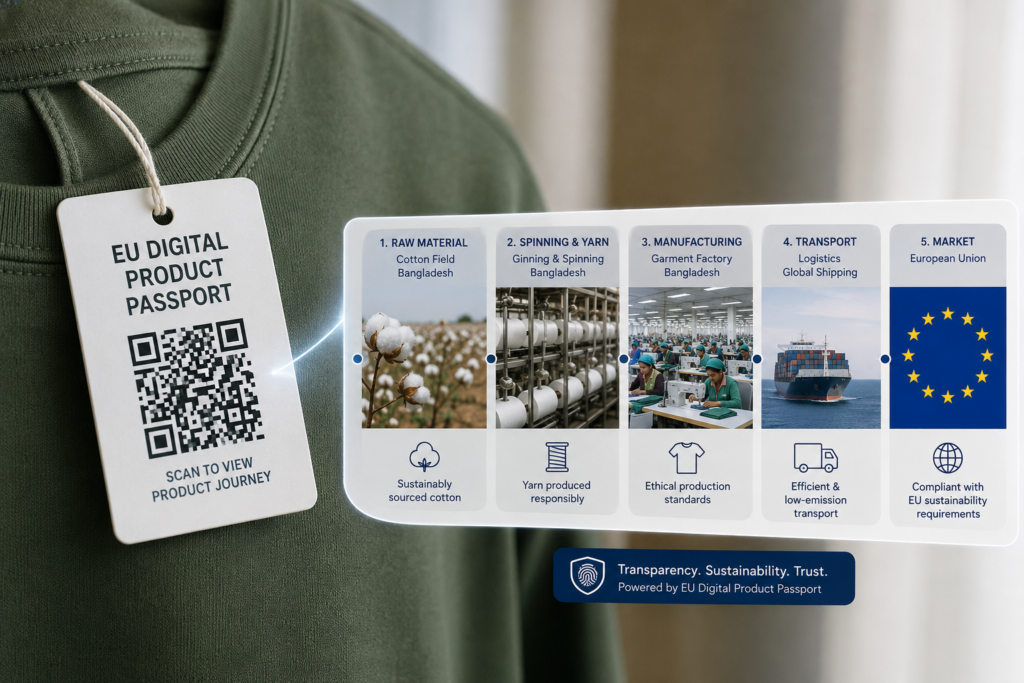
Every garment entering Europe needs a digital ID by 2027 — Bangladesh has 18 months

The EU's Digital Product Passport is not a distant policy experiment. It is a binding requirement that will determine which factories European buyers keep sourcing from. The countdown has started.

Share On:

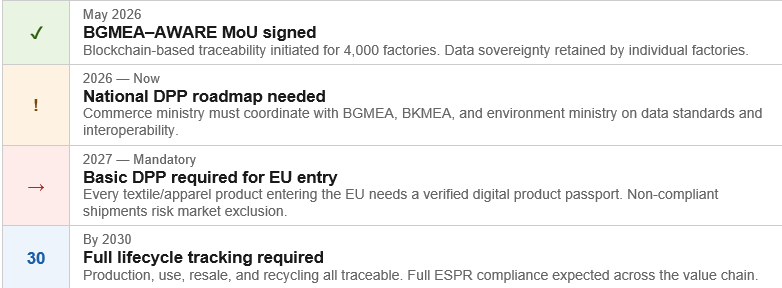
From 2027, every textile and apparel product entering the European Union must carry a Digital Product Passport (DPP) — a scannable, tamper-proof record of the product’s material origin, production journey, and environmental footprint. For Bangladesh, with EU exports reaching $19.7 billion in FY2024–25 and accounting for 50.1% of all exports to the world, this is an existential compliance requirement.

BGMEA has moved. In May 2026, it signed an MoU with Dutch traceability platform AWARE to introduce blockchain-based Digital Product Passports across Bangladesh’s 4,000 registered garment factories. Factories retain ownership of their own data.

The challenge is structural. More than 85% of Bangladesh’s garments are made from imported fibres and yarns. Under DPP, brands need verified proof of those materials’ origins — and a UNIDO study covering 104 textile companies found Bangladesh significantly trails in cross-supply-chain data sharing, EU regulatory understanding, and digital traceability infrastructure. Implementation will increase operational costs. Smaller factories face the largest relative burden.

The upside is real but conditional. Companies that successfully adopt DPP compliance will strengthen buyer relationships and secure longer-term sourcing contracts. Bangladesh has 268 LEED-certified factories — the groundwork of a credible sustainability story exists. The question is whether the sector can extend that story from building certification into full supply chain transparency, fast enough to meet the 2027 entry requirements.
Meet the Author

Share On:

Being read right now

Bangladesh’s Finance Minister Just Built the Legal Architecture for an Entire Sustainable Bond Market

Bangladesh's Finance Minister confirmed that amendments to debt securities rules will legally recognise green, blue, orange, and social bonds. A whistleblower protection act, a Capital Market Stabilisation Fund, and a new corporate governance code are in the same package. This is not one bond, it is the entire legal ecosystem for a sustainable capital market. It is years overdue and it is finally being built.

At ESG Institute Bangladesh, learn from global and local experts in sustainable development and join a community of professionals committed to making lasting change.

ESG Corporate Workshops

Expert learning on fundamentals of ESG and Sustainability for Corporates.
Learn more

ESG Student

Workshops

University sessions by corporate, policy and development sustainability experts on SDGs, Careers and Sustainability.
Learn more

ESG & Sustainability

Corporate Training

Curated, certified training on key SDG, ESG, Sustainability and Compliance experts from around the globe designed to build professional expertise.
Learn more

ESG-Sustainability

Professional Certifications

Build your professional career in ESG & Sustainability from globally recognized certifications and accreditions.
Learn more

ESG Professional Bootcamp

Learn from ESG-Sustainability experts and network with professionals in the industry in an engaging, 2-day Bootcamp centered on intensive learning on ESG and Sustainability for corporates.
Learn more

Contact Us

Contact the ESG Institute Bangladesh below, or send your contact information to request a callback from our representative.

Address

6th Floor, BIMS Bhaban, GA-9/3, Progoti Sharani, Dhaka-1212

Email

info@esginstitutebd.com

Call Us

+8801626658248