Each Bangladeshi garment carries 16 kg of CO₂ and a carbon tax bill nobody is ready for

The EU's Carbon Border Adjustment Mechanism entered its binding financial phase in January 2026. Garments aren't in scope yet — but the research just published says Bangladesh should start counting now.

Share On:

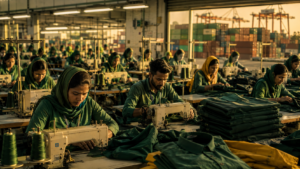
A peer-reviewed preprint published on Research Square in June 2026 has produced the first primary-data carbon and water footprint inventory of Bangladesh’s ready-made garment (RMG) sector. Covering 32 representative factories across knit, woven, and denim product lines, the study finds a sector-weighted mean carbon footprint of 16.0 kg CO₂-equivalent per kilogram of finished garment (cradle to gate).

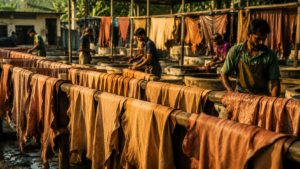
Where does that carbon come from? Upstream activities — fibre and yarn production, mostly imported — contribute about 42%. Grid electricity accounts for 27%, onsite combustion and effluent treatment 25%, and export freight 6%. The mean blue-water footprint is 136 litres per kilogram; grey-water footprint 119 litres per kilogram.

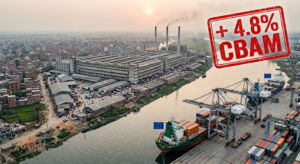
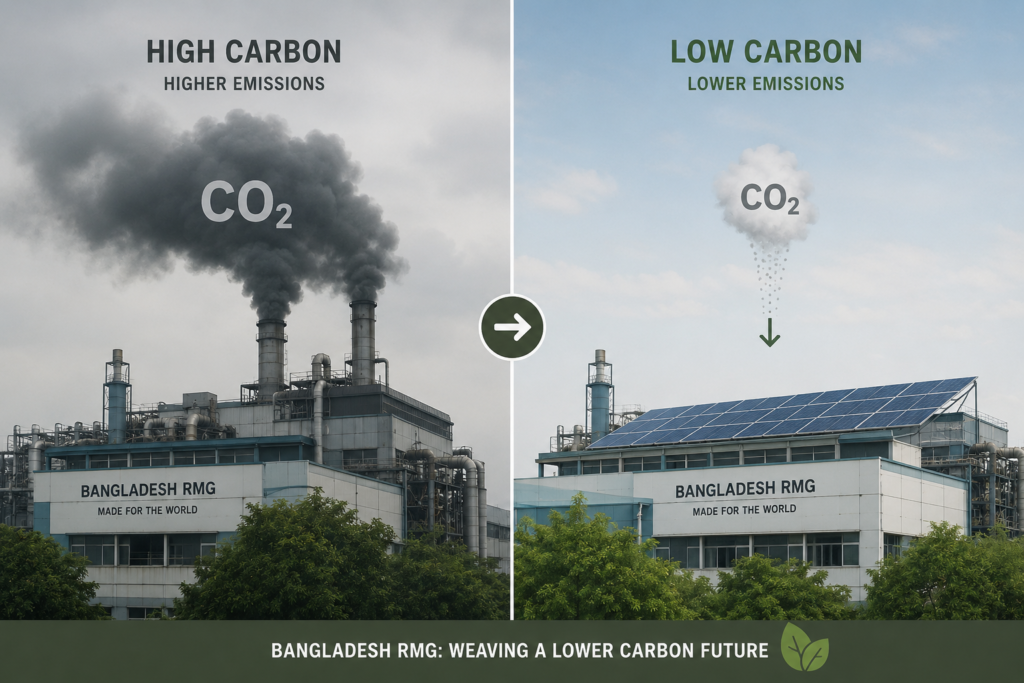
The EU’s Carbon Border Adjustment Mechanism (CBAM) entered its definitive, financially binding phase on January 1, 2026. Garments are not currently in scope, but the European Commission has signalled its intention to extend CBAM to downstream products across the decade. At a CBAM certificate price of €100 per tonne CO₂, the study models an exposure of approximately 4.8% of free-on-board export value under business as usual. A modelled decarbonisation pathway — combining energy efficiency, rooftop solar, renewable PPAs, process-heat electrification, low-impact dyeing, and recycled-fibre substitution — reduces that exposure to approximately 1.3%. A 54% footprint reduction is achievable. But it requires strategy, investment, and verified measurement. Bangladesh’s exporters cannot manage what they cannot measure.

CARBON FOOTPRINT BREAKDOWN — 16 KG CO₂ PER KG OF GARMENT

Carbon sourceShare of totalKey driver
Upstream — fibre & yarn production42%Mostly imported from India, China
Grid electricity27%Coal-heavy national grid
Onsite combustion & effluent treatment25%Factory operations
Export freight6%Shipping to EU markets

CBAM EXPOSURE REDUCTION WITH DECARBONISATION

Business as usual — CBAM exposure 4.8% of FOB export value at €100/t CO₂With decarbonisation pathway 1.3% 54% footprint reduction achievableBlue-water footprint (wet processing) 136 L/kg of garment producedStudy factory coverage 32 factories knit, woven & denim

Meet the Author

Share On:

Being read right now

Bangladesh Exported $3.14 Billion in Garments Last Month. Now Read What That Number Is Hiding.

Bangladesh RMG exports: $3.14 billion in April 2026 — up 31.21% year-on-year. Knitwear: +30.02%. Woven: +32.65%. Technically accurate. Also deeply misleading. April 2025 was one of the worst export months in recent history: Eid shutdown, India's transshipment ban, and US tariff shock all hit simultaneously. The 31% is measured against a collapsed floor. This is a live example of exactly what ISSB disclosure standards exist to prevent: data without context.

Bangladesh RMG Exports May Face 4.8% EU Carbon Tax After 2030

Your factory passed its audit. Your compliance paperwork is filed. Your buyer is happy. And yet, by 2030, you may be paying an extra 5% on every shipment to Europe — not because you broke a rule, but because you never learned to measure your carbon.

At ESG Institute Bangladesh, learn from global and local experts in sustainable development and join a community of professionals committed to making lasting change.

ESG Corporate Workshops

Expert learning on fundamentals of ESG and Sustainability for Corporates.
Learn more

ESG Student

Workshops

University sessions by corporate, policy and development sustainability experts on SDGs, Careers and Sustainability.
Learn more

ESG & Sustainability

Corporate Training

Curated, certified training on key SDG, ESG, Sustainability and Compliance experts from around the globe designed to build professional expertise.
Learn more

ESG-Sustainability

Professional Certifications

Build your professional career in ESG & Sustainability from globally recognized certifications and accreditions.
Learn more

ESG Professional Bootcamp

Learn from ESG-Sustainability experts and network with professionals in the industry in an engaging, 2-day Bootcamp centered on intensive learning on ESG and Sustainability for corporates.
Learn more

Contact Us

Contact the ESG Institute Bangladesh below, or send your contact information to request a callback from our representative.

Address

6th Floor, BIMS Bhaban, GA-9/3, Progoti Sharani, Dhaka-1212

Email

info@esginstitutebd.com

Call Us

+8801626658248