India’s EU trade deal is Bangladesh’s biggest competitive threat in a generation

The 'mother of all deals' between India and the EU wipes out the 9–12% tariff cushion Bangladesh has relied on for decades. With LDC graduation also coming in November 2026, the tariff clock is ticking on two fronts simultaneously.

Share On:

On January 27, 2026, India and the European Union concluded a comprehensive Free Trade Agreement dubbed the ‘mother of all deals.’ The pact eliminates duties on more than 99% of Indian exports to the EU — including apparel and textiles, which previously faced tariffs of 9–12%, and leather and footwear, which faced up to 17%.

For Bangladesh, the implications are severe. Bangladeshi garments entered the EU duty-free under the Everything But Arms scheme for least-developed countries, while Indian goods faced those 9–12% tariffs. That margin — a structural price advantage — is now gone. India has a vertically integrated ‘cotton-to-garment’ supply chain that Bangladesh cannot match. Bangladesh imports over 85% of its raw materials.

The timing compounds the damage. Bangladesh graduates from LDC status in November 2026. During a three-year transition period, duty-free access continues. But from November 2029, if Bangladesh has not secured GSP+ eligibility or a bilateral arrangement, tariffs on Bangladeshi apparel could snap back to approximately 12% — exactly when India pays zero. Modelling by RAPID estimates garment export losses of over $5.7 billion in that scenario, and a 36.5% total export decline under GTAP simulation.

Trade analysts are clear: the response must go beyond tariffs. EU due diligence laws, mandatory sustainability disclosures, CBAM carbon pricing, and the Digital Product Passport create a multi-layered compliance environment. A Bangladesh that can demonstrate ESG credibility — environmental performance, social standards, transparent governance — has a differentiating argument even at tariff parity. Without that, price competition alone against India and Vietnam will be very difficult to win.

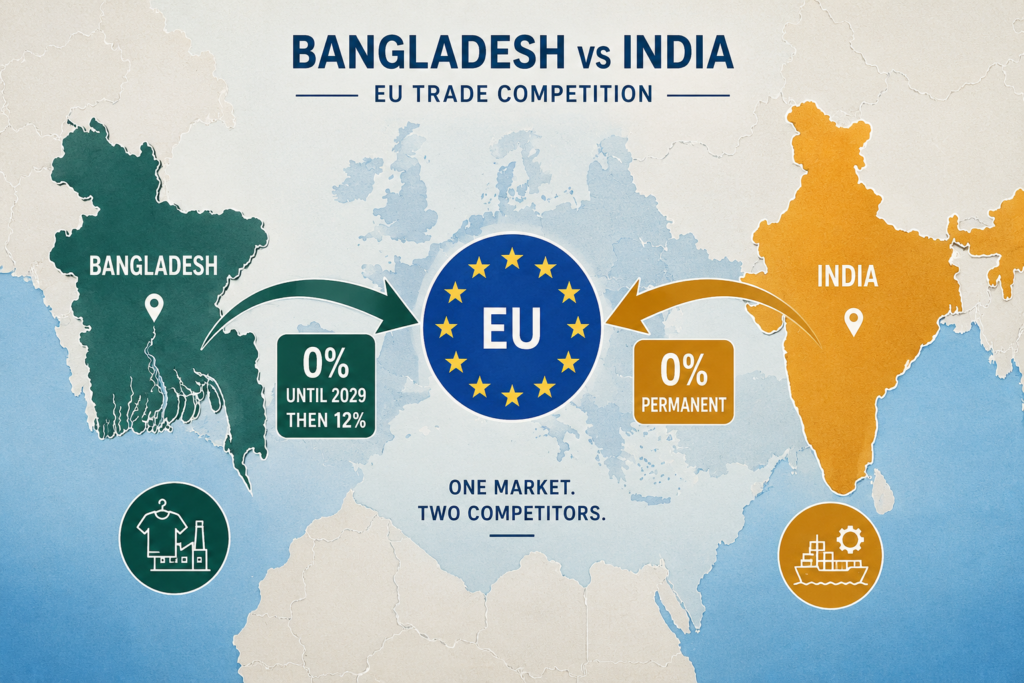
THE TARIFF GAP — BEFORE AND AFTER

Country / ScenarioEU Tariff on GarmentsStatus
Bangladesh — now (EBA scheme)0%Active until Nov 2029
Bangladesh — post-2029 if no GSP+~12%Cliff edge risk
India — pre-FTA (MFN tariff)9–12%Now eliminated
India — post-FTA0%Permanent

PROJECTED EXPORT IMPACT — RAPID & GTAP MODELLING

Export loss — LDC prefs retained $190M garment decline from India FTA aloneExport loss — post-graduation, no GSP+ $5.7B+ combined impact of FTA + LDC lossGTAP export decline scenario 36.5% total exports if facing MFN vs India at 0%EU share of Bangladesh exports ~50% nearly all in textiles & apparel

Meet the Author

Share On:

Being read right now

Bangladesh’s Finance Minister Just Built the Legal Architecture for an Entire Sustainable Bond Market

Bangladesh's Finance Minister confirmed that amendments to debt securities rules will legally recognise green, blue, orange, and social bonds. A whistleblower protection act, a Capital Market Stabilisation Fund, and a new corporate governance code are in the same package. This is not one bond, it is the entire legal ecosystem for a sustainable capital market. It is years overdue and it is finally being built.

Bangladesh’s Top Regulators Just Said the Quiet Part Out Loud: Learn ESG Reporting Now

At a recent seminar in Dhaka, leaders from the stock exchange, the central bank, and the accounting profession delivered the same blunt message from four different podiums: sustainability reporting is no longer optional, and most companies aren't ready for it. When regulators start speaking with one voice, it usually means the deadline is closer than it looks.

Bangladesh Could Qualify for GSP+ and Still Lose Duty-Free Access to Europe

Brussels has just rewritten the rulebook that will decide whether Bangladesh's garment industry keeps tariff-free access to its biggest market after LDC graduation. The twist: even meeting every requirement for the EU's preferential GSP+ scheme may not be enough — a single statistical threshold could push apparel exports back to full tariffs anyway. For an industry that sends more than half its exports to Europe, understanding the fine print has never mattered more.

At ESG Institute Bangladesh, learn from global and local experts in sustainable development and join a community of professionals committed to making lasting change.

ESG Corporate Workshops

Expert learning on fundamentals of ESG and Sustainability for Corporates.
Learn more

ESG Student

Workshops

University sessions by corporate, policy and development sustainability experts on SDGs, Careers and Sustainability.
Learn more

ESG & Sustainability

Corporate Training

Curated, certified training on key SDG, ESG, Sustainability and Compliance experts from around the globe designed to build professional expertise.
Learn more

ESG-Sustainability

Professional Certifications

Build your professional career in ESG & Sustainability from globally recognized certifications and accreditions.
Learn more

ESG Professional Bootcamp

Learn from ESG-Sustainability experts and network with professionals in the industry in an engaging, 2-day Bootcamp centered on intensive learning on ESG and Sustainability for corporates.
Learn more

Contact Us

Contact the ESG Institute Bangladesh below, or send your contact information to request a callback from our representative.

Address

6th Floor, BIMS Bhaban, GA-9/3, Progoti Sharani, Dhaka-1212

Email

info@esginstitutebd.com

Call Us

+8801626658248