
 Regulation
ISSA 5000, the first stand-alone global standard for assuring sustainability information, takes effect for reporting periods beginning on or after 15 December 2026. It covers every ESG topic and works with any reporting framework. The question for reporters is not whether someone will ask for proof, but whether they will be ready.

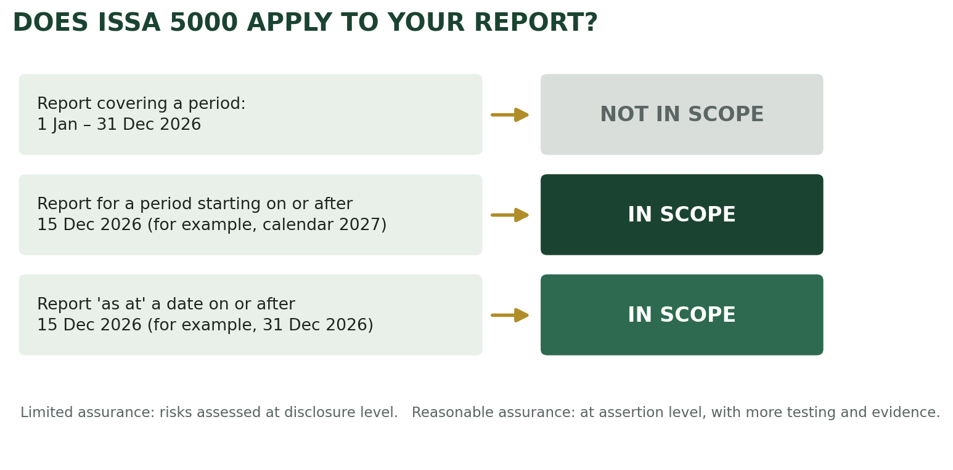
How the ISSA 5000 effective date works, based on PwC’s reading of the standard. The 2027 example is illustrative.
Sustainability reports have long carried the word ‘verified’ without anyone agreeing on what it meant. On 15 December 2026 that begins to change. ISSA 5000, issued by the International Auditing and Assurance Standards Board, becomes effective.
It is the first comprehensive, stand-alone global standard for assuring sustainability information. It applies to all ESG topics, can be used with any reporting framework or several at once, and covers both limited and reasonable assurance. A companion ethics standard for sustainability assurance takes effect on the same date.
The effective date is easy to misread. ISSA 5000 applies to assurance on sustainability information reported for periods beginning on or after 15 December 2026, or reported as at a specific date on or after that day. It is not a rule about engagements that start after December 2026. A report covering calendar 2026 falls outside it. A calendar 2027 report falls inside, and so does a point-in-time report as at 31 December 2026.
The two levels of assurance differ in depth. In limited assurance, the practitioner assesses the risk of material misstatement at the level of each disclosure. In reasonable assurance, that assessment happens at the assertion level for each disclosure, which means more testing and more evidence. Practitioner guidance suggests most first engagements will be limited assurance.
The standard is also designed to be profession-neutral. Practitioner commentary notes that it lets assurance providers from different backgrounds, including engineers and other sustainability specialists, carry out engagements alongside accountants.
For Bangladesh, the timing is pointed. The Financial Reporting Council has adopted the ISSB’s sustainability reporting standards, and banks have been told to report on them. As reports multiply, the question of who gives assurance follows. We could not confirm whether Bangladesh has adopted ISSA 5000 locally. In the region, Pakistan’s ICAP is reported to have adopted it, effective from December 2026.
Companies issuing green bonds or borrowing against sustainability targets have an added reason to care, because investors and lenders will want numbers they can rely on.
Global standards demand local capability. Your organisation must know exactly what an assurance provider will ask for, where the evidence is held, and who is responsible for producing it.
Regulation Regulation
 Regulation
Hivedemy turns ESG into short, hands-on lessons built and checked by professionals worldwide. Every lesson teaches first, then asks you to do the work, and every attempt gets a reason.