
 Regulation
Since 19 July, large companies in the EU can no longer destroy unsold clothes and shoes. The digital product passport for textiles, by contrast, is not yet required, with rules expected in 2027. Separating the two matters for exporters deciding what to prepare for now.

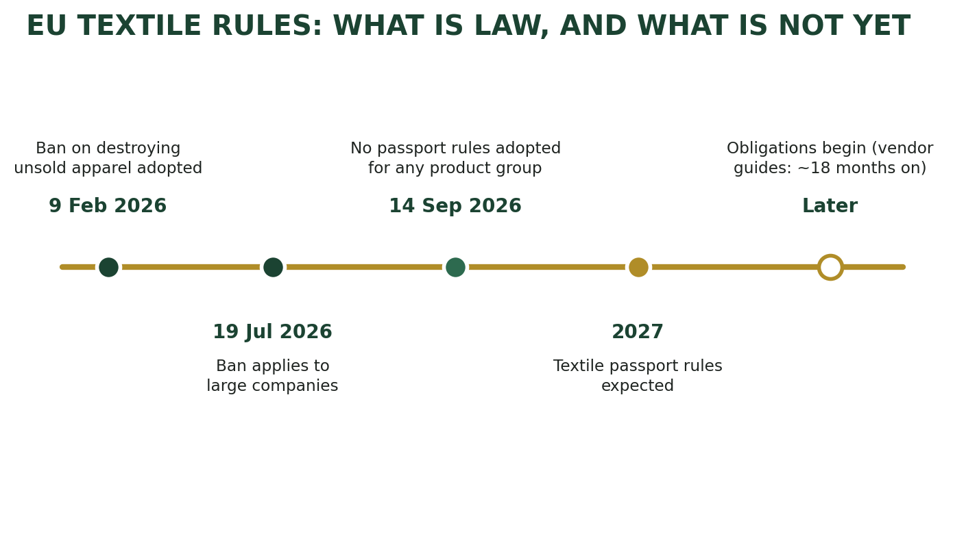
Key dates for two EU measures under the Ecodesign for Sustainable Products Regulation. The ‘later’ obligation date is a vendor estimate, not an official date.
Two EU measures are often mentioned in the same breath. One is law. The other is still a plan.
The law first. Since 19 July 2026, large companies have been barred from destroying unsold apparel, clothing accessories and footwear, except under one of ten listed derogations. The detailed rules sit in Delegated Regulation (EU) 2026/296, adopted on 9 February 2026 under the Ecodesign for Sustainable Products Regulation (ESPR).
Now the plan. A Digital Product Passport for textiles is not yet required. Under ESPR, a passport reaches a product group only once the Commission adopts a delegated act for it. As of 14 September 2026, the Commission had adopted none for any product group. Textiles are on the working plan for 2027, and the Commission’s own page points to the third or fourth quarter of 2027. Vendor guides suggest obligations would then apply roughly 18 months after adoption.
That is why some claims about 2027 deserve a second look. The date a rule is adopted and the date it begins to bite are different things.
Bangladesh’s industry is not waiting. In May, BGMEA signed an agreement with the Dutch platform AWARE to build passport capability across its member factories, and reports put the number at around 4,000. Because the industry relies heavily on imported fibres and yarns, origin data has to travel with the shipment. The factory keeps ownership of its data, and pilots are planned with spinners and garment makers.
Preparing early makes sense, but preparing accurately makes more. Companies that already hold clean data on products, materials and suppliers will be better placed whichever date holds. Those chasing the wrong deadline risk spending effort in the wrong place.
Exporters must be able to distinguish between current legal requirements, upcoming regulations, and buyer-specific expectations. An organisation needs designated people who can assess each requirement, determine its implications, and guide the business response.
Regulation Regulation
 Climate Change
Hivedemy turns ESG into short, hands-on lessons built and checked by professionals worldwide. Every lesson teaches first, then asks you to do the work, and every attempt gets a reason.