
 Regulation
The Science Based Targets initiative published version 2.0 of its Net-Zero Standard on 11 June. It formally recognises carbon credits, asks larger electricity users to report hourly-matched energy, and moves from validation toward tracking. Companies with SBTi-linked buyers should read the fine print.
Many corporate climate targets rest on one rulebook. In June, it was rewritten. The Science Based Targets initiative (SBTi) published version 2.0 of its Corporate Net-Zero Standard on 11 June 2026.
The change is phased. Validation of targets under version 2.0 is expected to begin in February 2027. Companies can continue to submit under the older criteria, Near-Term Criteria V5.3 and Net-Zero Standard V1.3.1, until 31 January 2028. Renewals and new targets from 2028 are expected to follow version 2.0.
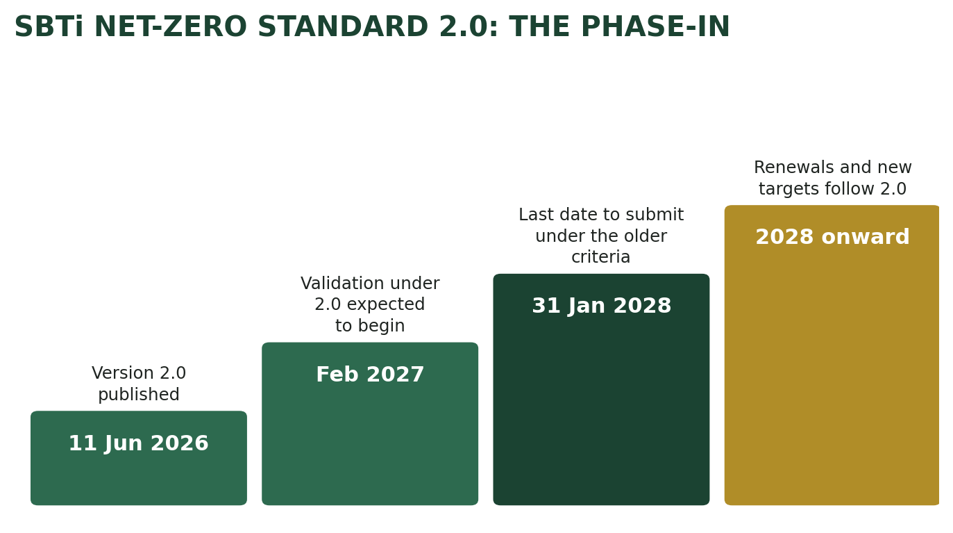
Phase-in dates for SBTi’s Corporate Net-Zero Standard 2.0, as summarised by law firms Rajah & Tann and Beveridge & Diamond.
Carbon credits are one of the biggest shifts. According to law firm summaries, version 2.0 formally recognises carbon credits as a credible tool within corporate climate strategies. That ends a long debate about whether credits belong in a net-zero plan at all, and starts a new one about which credits qualify.
Electricity gets closer scrutiny. Larger electricity users are asked to report the hourly-matched share of their power coming from clean sources. An optional recognition programme is reported to reward at least 50 percent hourly matching, rising to 90 percent by 2035. That moves the question from how much clean power a company buys to when it is available.
The standard also shifts emphasis from validation toward implementation and tracking. A target on paper counts for less than evidence of delivery.
Why should a Bangladeshi manufacturer care? Because the buyers it supplies may be among the companies setting targets under this standard. The summaries are written for corporates in general, but the logic reaches suppliers- when a company must track delivery and electricity sourcing, it will want data from the factories in its supply chain.
That data has to be measured, consistent and defensible. Many suppliers have energy bills and little else. Knowing the difference between a number you can state and a number you can prove is where the work begins.
Regulation Regulation
 Climate Change
Hivedemy turns ESG into short, hands-on lessons built and checked by professionals worldwide. Every lesson teaches first, then asks you to do the work, and every attempt gets a reason.