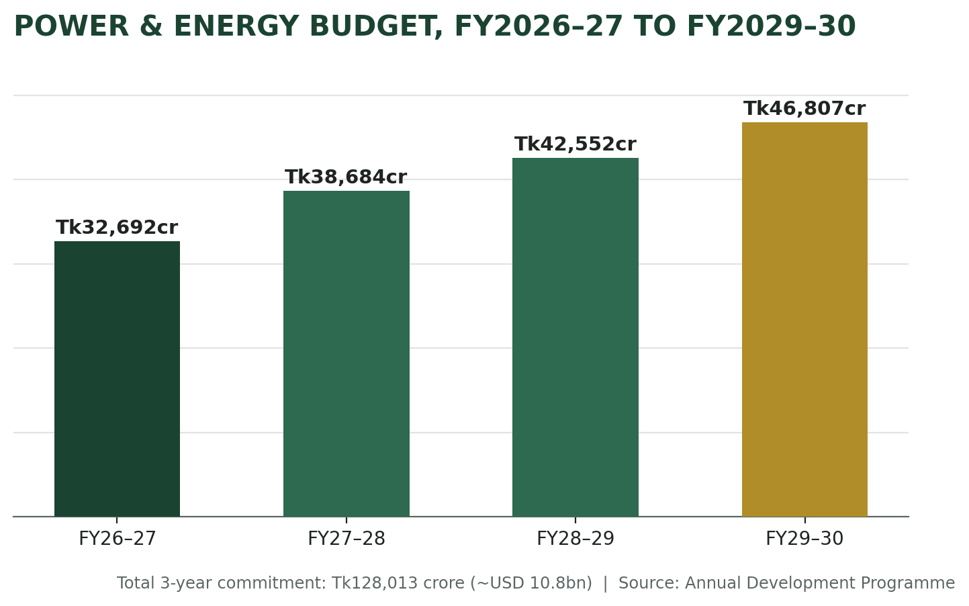
Fiscal-year funding trajectory under the government’s latest Annual Development Program for power and energy.
Bangladesh has put a number on its energy ambitions: Tk128,013 crore, roughly $10.8 billion, spread across the next three fiscal years. It’s the country’s most concrete answer yet to a question that has dogged its industrial growth for years — how do you power rapid urbanisation and export-driven manufacturing without the grid buckling, or the climate bill spiralling?
The plan, detailed in the government’s latest Annual Development Programme, allocates Tk32,691.54 crore to power and energy in FY2026–27 alone — nearly 11% of the national development budget. That share climbs every year through FY2029–30, when annual allocation is projected to reach Tk46,807 crore. According to Planning Secretary SM Shakil Akhtar, the ambition isn’t just more generation capacity; it’s fixing the parts of the system that quietly waste power — transmission losses, distribution inefficiencies, and the technology gap that leaves large parts of the grid running on decades-old infrastructure.
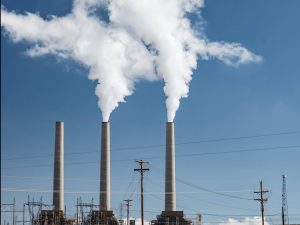
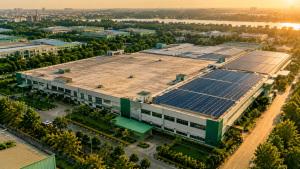
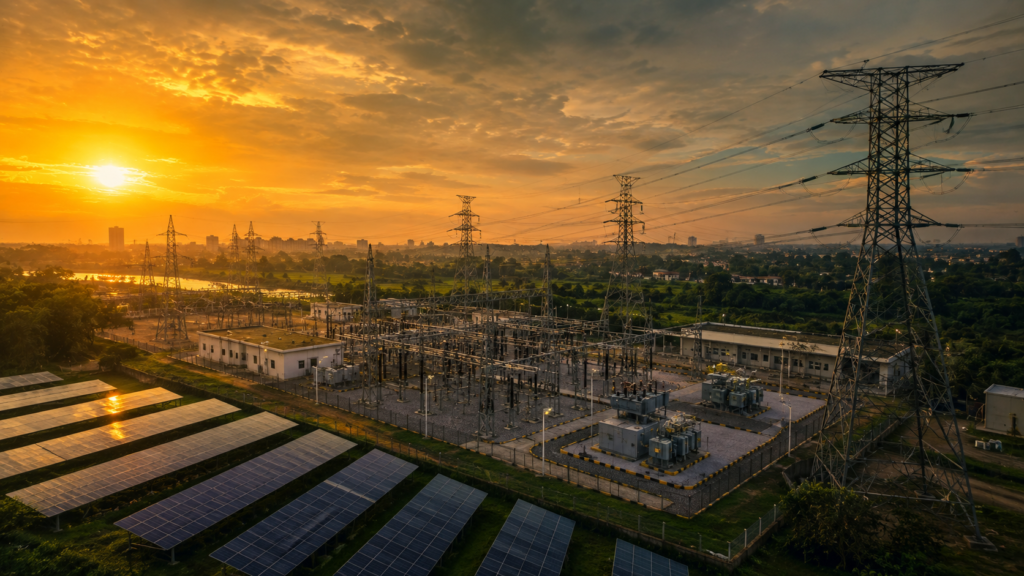
Six strategic priorities anchor the plan: affordable and reliable power, a balanced fuel mix, scaled-up renewables, a modernised and secure grid, smart-grid technology including SCADA systems, and reduced system losses. On paper, it reads like a clean-energy roadmap. In practice, the flagship projects tell a more complicated story — the Matarbari coal-fired plant and the Rooppur nuclear facility sit alongside solar parks and off-grid renewable initiatives aimed at rural and agricultural communities.
That mix is the real story here. Bangladesh isn’t choosing between fossil fuels and renewables — it’s trying to do both simultaneously, betting that domestic gas exploration, LNG imports, nuclear baseload and solar expansion can somehow all scale together fast enough to meet demand from a rapidly industrialising economy. The plan folds in 47 new projects this fiscal year alone: 11 in generation, 10 in distribution, 21 energy-related schemes, and even mineral exploration tied to fuel security.
The honest read is that this is an infrastructure sprint, not a renewable energy pledge. Whether the ‘balanced energy mix’ language survives contact with financing realities, land constraints and construction timelines is the question every investor, lender and industrial energy buyer in Bangladesh should be tracking closely over the next three fiscal cycles. For companies planning long-term energy procurement or emissions strategy, this is the moment to understand exactly where the grid — and the carbon intensity behind it — is actually heading, not just where policy says it should.