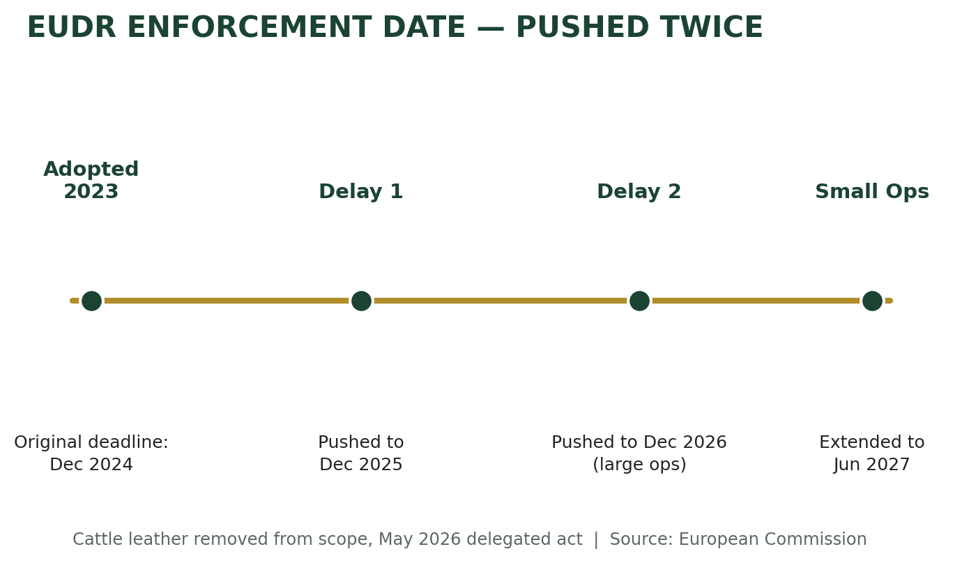
EUDR’s enforcement date has slipped twice since 2023. Cattle leather was formally removed from scope via a May 2026 Commission delegated act.
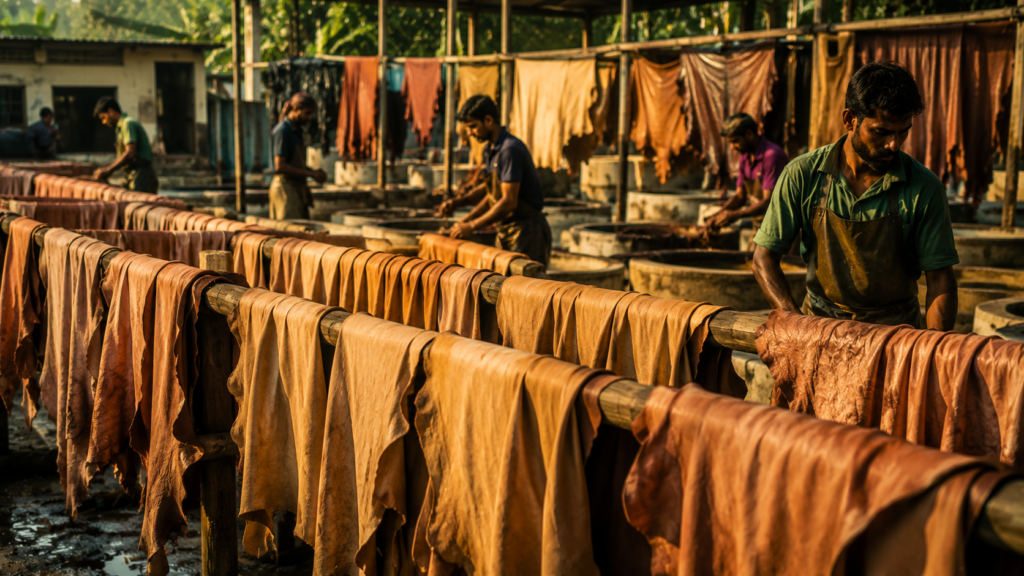
For Bangladesh’s leather and footwear exporters, a compliance burden they were bracing for just got lighter — at least for now. The European Commission has moved to exclude cattle leather from the scope of its landmark Deforestation Regulation, following sustained lobbying from tanning and leather industry groups across Europe and beyond.
The EU Deforestation Regulation, EUDR for short, requires that products derived from seven commodities — including cattle, cocoa, coffee, palm oil, rubber, soy and wood — be certified as deforestation-free before entering the EU market. Under the version adopted in 2023, leather goods fell squarely within scope as a cattle-derived product. That’s now changing: the Commission’s delegated act, published in May 2026, formally removes cattle leather from Annex I, alongside a narrowing of the retreaded tyre category, while adding soluble coffee and certain palm oil derivatives to the list.
The change comes wrapped inside a broader story of delay and simplification. EUDR was originally meant to take effect on 30 December 2024. It has since been postponed twice — first to December 2025, then again to 30 December 2026 for large operators, with micro and small enterprises given until June 2027. Each delay has come with loosened requirements, prompting some environmental groups to warn that the regulation’s core ambition is being quietly diluted even as its enforcement date approaches.
For Bangladesh, the practical effect is immediate relief for one specific export category. Leather and leather goods are a meaningful, if secondary, export earner behind the dominant ready-made garment sector, and tanneries — many clustered around the Savar leather industrial park — had been bracing for the same supply-chain traceability and deforestation-free certification burden that cattle producers in Brazil or timber exporters elsewhere now face.
But this is not a reason to relax. The regulation’s core machinery — due diligence obligations, geolocation traceability, and legality verification — remains intact and is still scheduled to bite from December 2026 for large operators across every other in-scope commodity Bangladesh trades with the EU, including any wood, rubber or palm-oil-linked inputs used across its manufacturing sectors. And crucially, this is a delegated act, not yet final law — it remains subject to a scrutiny period by the European Parliament and Council, meaning today’s exemption could still be challenged or reversed before it locks in.
The broader lesson for Bangladeshi exporters watching from outside the EU: European sustainability regulation is not static, and reacting only once a rule is finalised is a losing strategy. The companies best positioned through this cycle of delays, exemptions and re-scoping have been the ones that built traceability and due diligence capability early, regardless of which commodity list they currently sit on — because that list has proven, repeatedly, that it can change.