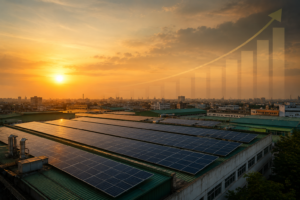
On June 5, 2026, Finance Minister Amir Khosru’s budget speech contained a sentence that Bangladesh’s renewable energy community had been waiting three years to hear: solar power generation would be fully exempt from all taxes until 2035, and all solar equipment imports would be duty-free until 2031. The response from ActionAid Bangladesh and JETnet-BD — the just energy transition network spanning NGOs, researchers, and climate advocates — was immediate: ‘a milestone for Bangladesh’s just energy transition.’

Solar policy journey speedometer — from the 58.6% red zone to the 0% green milestone achieved in FY27. The gauge marks the reform win; the needle points to the implementation challenge that begins now.
The milestone framing is both accurate and deliberate. In advocacy language, a milestone is a point reached on a longer journey — recognition of progress without suggesting the work is complete. The civil society organisations that pushed for this reform for three years are also the ones most focused on what must happen next for the reform to deliver on its promise.
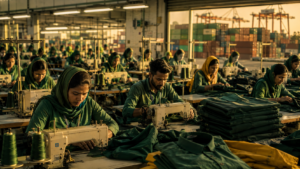
The ‘just’ in just transition is the key qualifier. Large exporters — Ha-Meem Group, DBL Group, Beximco — were already installing solar while the 58.6% duty was in place, because they could absorb the cost premium and because their EU buyer relationships made the investment commercially rational. The duty removal benefits them further. But it is the thousands of SME factories — operations with 200 to 1,000 workers, running on thin margins, with limited banking relationships and no in-house engineering capacity — where the just transition question becomes most acute.
Ha-Meem built 12 MW of solar while the duty was 58.6%. The duty removal benefits them further. The question is whether it reaches the factory that could not afford to act when the duty was in place.
For those factories, zero duty is a necessary condition for solar adoption — but it is not sufficient. A 300-worker factory in Savar still needs access to solar-specific bank financing with appropriate tenors and grace periods. It needs access to certified installers who can design, supply, and commission a system reliably. It needs a net-metering connection approval process that does not take 18 months. It needs assurance that surplus electricity it exports to the grid will be credited at a fair rate. None of these exist at adequate scale or quality in Bangladesh today.
The budget milestone is real and worth celebrating. Three years of sustained advocacy from civil society, industry, and climate researchers produced a concrete policy change that will accelerate Bangladesh’s energy transition. ActionAid’s framing — a milestone, not a destination — is exactly right. The next campaign is already being designed: SME solar financing access, certified installer network development, and a net metering process reform that treats factory-level solar as the industrial policy priority it has now officially become.