On January 7, 2026, researchers at the Jiangsu Provincial Geological Survey Institute announced a result that made geothermal energy specialists pay attention: the Yangshen 1 well in Xiaoyangkou, Rudong County had generated electricity from a deep geothermal source for the first time in the province’s history. The well, drilled to a depth of 3,501.66 metres — the deepest hydrothermal well ever completed in Jiangsu — recorded a wellhead temperature of 108°C and a daily water output of 5,360 cubic metres. Using an Organic Rankine Cycle generator, the project produced over 200 kilowatts of electricity. Small by any grid measure. Significant as a proof of concept on a geology that extends across China’s eastern coastal zone.
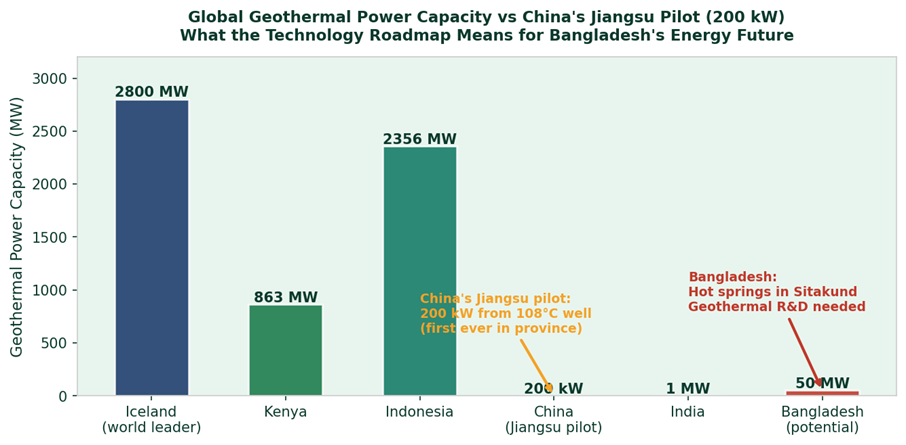
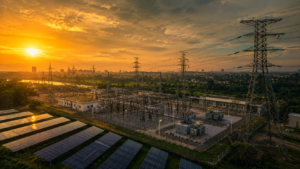
Global geothermal capacity vs China’s Jiangsu 200 kW pilot and Bangladesh’s estimated potential — the technology roadmap and what the Jiangsu breakthrough means for South Asia’s energy planning
Jiangsu Province sits on the eastern coastal sedimentary basin of China — a geological environment characterised by deep saline aquifers, sedimentary layers with significant heat retention, and subsurface temperatures that rise predictably with depth. The ‘Yangshen 1’ well used what Chinese engineers describe as ‘thermal wave resistance’ site-selection technology and a hybrid drilling system designed for deep, water-covered, hard-rock formations. The breakthrough is not in the science — geothermal power generation from medium-enthalpy resources (100–150°C) is established technology. The breakthrough is in demonstrating that it works on this specific geological profile.
Kenya runs 47% of its national electricity grid on geothermal. Iceland is 100% renewable — mostly geothermal. Bangladesh has one documented hot spring and zero geothermal exploration policy.
Why does a 200 kW pilot in Jiangsu matter to Bangladesh? Because Bangladesh sits on the northern extension of the same eastern coastal geological framework. Chittagong’s geological surveys — conducted primarily for gas exploration — have recorded geothermal gradients consistent with low-to-medium enthalpy resources. Sitakund, north of Chattogram, has documented natural hot springs — surface expressions of subsurface heat that indicate the kind of geothermal potential the Jiangsu project has now demonstrated can be converted to electricity using modern ORC technology.
The contrast with Bangladesh’s current energy investment priorities is stark. Bangladesh is currently spending approximately Tk 390 million monthly in LNG subsidies. It is debating whether to remove the 58.6% import duty on solar panels. It has cancelled 33-34 mature renewable energy projects in the past two years. Geothermal exploration is not on the policy agenda. The National Renewable Energy Policy mentions geothermal as a potential resource but allocates no research funding, no geological survey budget, and no pilot project mandate.
Geothermal energy has one characteristic that solar and wind do not: it generates power 24 hours a day, seven days a week, regardless of weather, cloud cover, or time of day. For a country with chronic load-shedding driven partly by the intermittency challenges of rapid solar scale-up, baseload clean energy from geothermal would be transformative. Kenya, which began geothermal exploration in 1956, now runs 47% of its national grid on geothermal power. The Jiangsu pilot is proof that the technology is now accessible on geological profiles similar to Bangladesh’s eastern coastal zone. The question worth asking — loudly, and soon — is whether anyone in Bangladesh’s energy planning institutions is reading the data coming out of Rudong County.