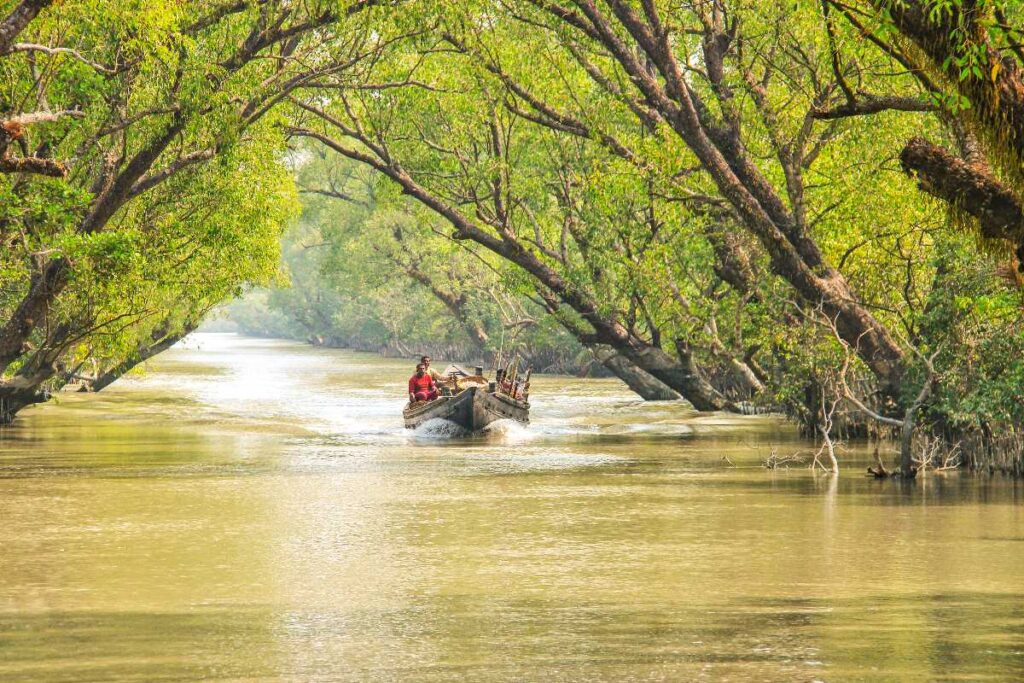
A study published in Communications Earth & Environment, analysing 25 years of satellite imagery from February 2000 to December 2024, has found that between 10 and 15 percent of the Sundarbans the UNESCO World Heritage mangrove forest shared by Bangladesh and India has experienced a measurable decline in its ability to recover from environmental stress. The degraded area amounts to between 610 and 990 square kilometres of a forest system that took millennia to form.
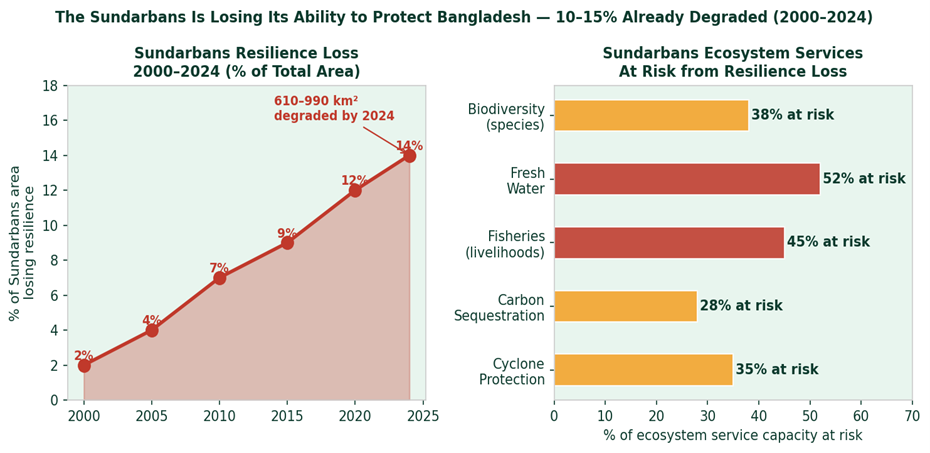
Left: Sundarbans resilience loss 2000–2024 from 2% to 14% of total area degraded. Right: ecosystem services at risk from ongoing resilience loss fisheries and freshwater most exposed
The mechanism the researchers identify is what ecologists call ‘critical slowing down’, a process in which an ecosystem under repeated stress takes progressively longer to return to its baseline state after each disturbance. A mangrove forest that once recovered from a cyclone in weeks begins taking months. Then the recovery is incomplete. Then the next cyclone arrives before recovery is finished. Eventually the system stabilises at a lower level of ecological function less dense, less biodiverse, less capable of sequestering carbon or buffering storm surges.
10–15% of the Sundarbans has lost resilience over 25 years. The northern and coastal boundaries are the most degraded exactly where the human pressure and storm exposure are greatest.
The stressors are specific and documented. Cyclones Sidr, Aila, Amphan, and Yaas each caused measurable damage to mangrove canopy. Between cyclones, rising sea levels driven by climate change increase tidal inundation frequency, reducing the breathing time roots need between flood events. Salinity intrusion from reduced freshwater flows caused by upstream water extraction and changing monsoon patterns is altering species composition, disadvantaging high-value Sundari trees (Heritiera fomes) in favour of more salt-tolerant but ecologically less complex species. Human pressures illegal logging, honey and crab collection, shrimp farming along the periphery add incremental stress to a system already absorbing climate shocks.
Bangladesh’s approach to Sundarbans conservation has been too narrowly focused on protection restricting access, patrolling boundaries without addressing the underlying drivers that are weakening the forest from within. The authors call for a more integrated approach: restoring freshwater flows, controlling upstream salinity through hydraulic management, supporting community-based resource management that gives forest-dependent communities economic incentives aligned with conservation rather than extraction.
The ESG dimension of Sundarbans degradation is direct and measurable. The forest provides an estimated $40 billion in ecosystem services to Bangladesh annually cyclone protection, carbon sequestration, fisheries nursery function, freshwater regulation. These are not abstract ecological values; they are economic assets that appear on no balance sheet but underpin the livelihoods of 35 million people in coastal southwestern Bangladesh. Any company operating in Bangladesh’s coastal economy, any financial institution with exposure to coastal agricultural value chains, and any insurer covering cyclone risk in the delta should be incorporating Sundarbans resilience data into their risk models. Natural capital is not a separate category from financial risk. In Bangladesh, it is the foundation of both.