Bangladesh Exported $3.14 Billion in Garments Last Month. Now Read What That Number Is Hiding.

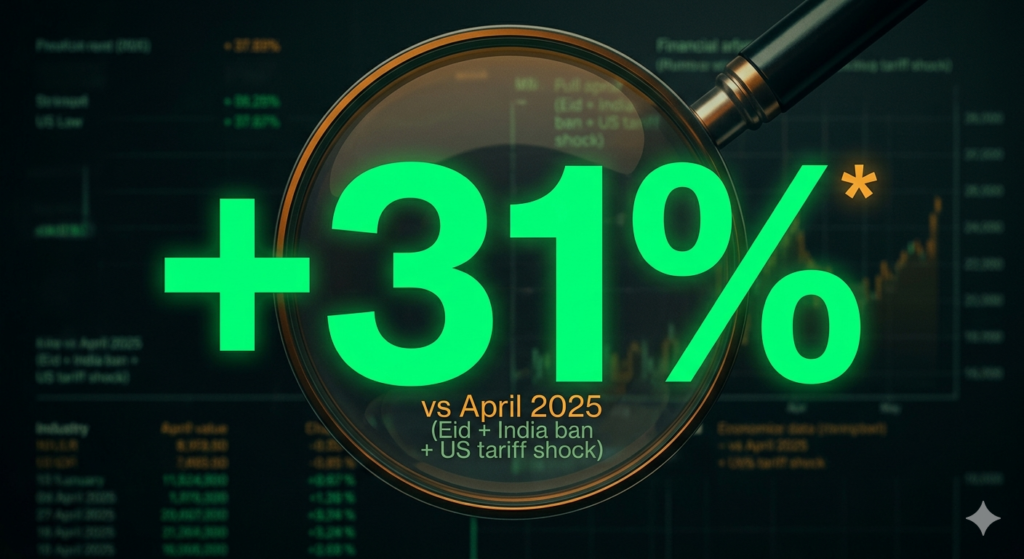
Bangladesh RMG exports: $3.14 billion in April 2026 — up 31.21% year-on-year. Knitwear: +30.02%. Woven: +32.65%. Technically accurate. Also deeply misleading. April 2025 was one of the worst export months in recent history: Eid shutdown, India's transshipment ban, and US tariff shock all hit simultaneously. The 31% is measured against a collapsed floor. This is a live example of exactly what ISSB disclosure standards exist to prevent: data without context.

Share On:

Bangladesh’s Export Promotion Bureau data published in early May 2026 shows RMG exports of $3.14 billion in April 2026 — a 31.21% year-on-year increase. Knitwear exports rose 30.02%. Woven garments climbed 32.65%. The numbers were reported prominently and met with celebration across industry and government communications.

The number is real. The framing deserves scrutiny.
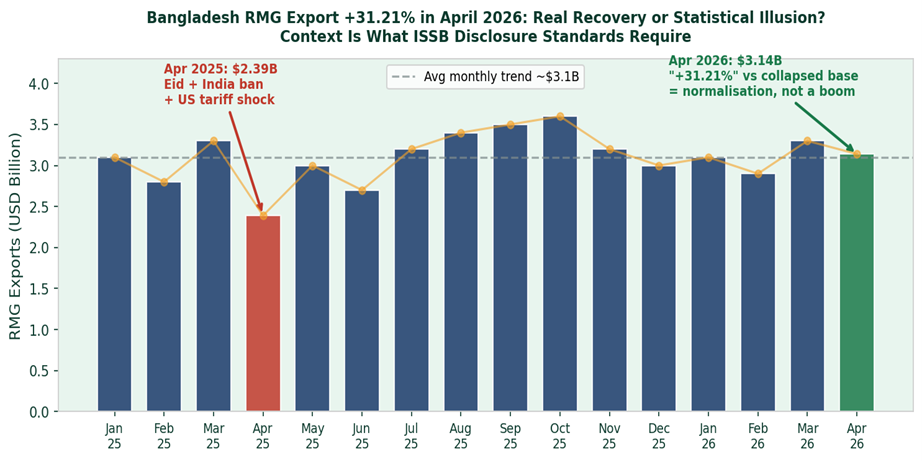
Month-by-month Bangladesh RMG exports showing April 2025’s artificial collapse and April 2026’s return to normal — the 31% “growth” is normalisation against a depressed base, not a new peak

April 2025 was an anomalous month by any industry measure. Three separate events compressed performance well below the sector’s running rate simultaneously. First: Eid-ul-Fitr fell in late March 2025, with the extended holiday running into April, reducing factory working days and delaying shipments across the board. Second: India revoked Bangladesh’s transshipment facility on April 8, 2025, disrupting an established logistics route and creating immediate shipment backlogs. Third: initial USTR Section 301 investigation announcements in March 2025 generated buyer uncertainty, with some orders paused during April. The result was an April 2025 export figure of $2.39 billion — significantly below the sector’s typical monthly range of $3.0–3.4 billion.

Industry insiders are explicit: April 2026 is normalisation, not a new high. Reporting it as 31% growth without this context is selective disclosure — exactly what ISSB standards are designed to prevent.

A 31.21% recovery from an artificially depressed base is not 31.21% organic growth. Industry insiders cited by Textile Focus are explicit: this represents normalisation, not exceptional performance. Reporting the headline figure without the base-effect context creates a materially misleading impression.

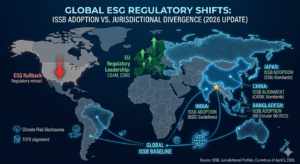
This matters beyond Bangladesh’s export statistics. It is a real-time demonstration of the core principle of ISSB sustainability disclosure standards: material context must accompany performance data. IFRS S1 requires that sustainability-related information — and all material metrics — be presented in a way that is complete, comparable, and free from material misstatement. Removing the asterisk is not transparency. It is selective reporting. The April 2026 export number is a perfect teaching case. Every sustainability metric your organisation reports deserves the same rigour: the number and its context are inseparable.


Meet the Author

Share On:

Being read right now

BSEC Is Rewriting the Rules. ESG Is No Longer Optional for Bangladesh’s Capital Market

Bangladesh's Securities and Exchange Commission is revising its Corporate Governance Code to make ESG reporting a legal requirement for all listed companies. The Financial Reporting Council is adopting ISSB climate and general disclosure standards. The PM's special assistant visited BSEC on April 16 specifically to review these reforms. When this law lands, 350 companies need trained ESG professionals. Today, 334 of them have never filed a standardised sustainability report.

Equipping Corporate Leaders with ESG Insights

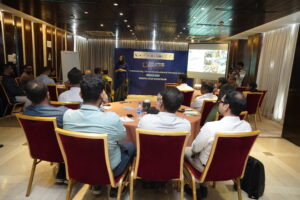
The “Foundation of ESG and Corporate Sustainability” certified day-long training program, jointly organized by the ESG Institute and UN Global Compact (UNGC) and closed by the Chief Guest Mominul Islam, Chairman, Dhaka Stock Exchange (DSE) Ltd., successfully convened over 100 corporate sustainability professionals from across the country.

At ESG Institute Bangladesh, learn from global and local experts in sustainable development and join a community of professionals committed to making lasting change.

ESG Corporate Workshops

Expert learning on fundamentals of ESG and Sustainability for Corporates.
Learn more

ESG Student

Workshops

University sessions by corporate, policy and development sustainability experts on SDGs, Careers and Sustainability.
Learn more

ESG & Sustainability

Corporate Training

Curated, certified training on key SDG, ESG, Sustainability and Compliance experts from around the globe designed to build professional expertise.
Learn more

ESG-Sustainability

Professional Certifications

Build your professional career in ESG & Sustainability from globally recognized certifications and accreditions.
Learn more

ESG Professional Bootcamp

Learn from ESG-Sustainability experts and network with professionals in the industry in an engaging, 2-day Bootcamp centered on intensive learning on ESG and Sustainability for corporates.
Learn more

Contact Us

Contact the ESG Institute Bangladesh below, or send your contact information to request a callback from our representative.

Address

6th Floor, BIMS Bhaban, GA-9/3, Progoti Sharani, Dhaka-1212

Email

info@esginstitutebd.com

Call Us

+8801626658248