In April 2026, Thailand completed the transfer of 49,717 Internationally Transferred Mitigation Outcomes ITMOs, the unit of account under Article 6 of the Paris Agreement to Switzerland as part of the Bangkok E-Bus Programme. The transaction was not novel in concept; it was the second such transfer from that programme, following 1,916 ITMOs transferred in late 2023. What makes it significant as a reference point for Bangladesh is the infrastructure that made it possible: independent validation, government registration, corresponding adjustments to prevent double-counting, and third-party verification by internationally accredited bodies.
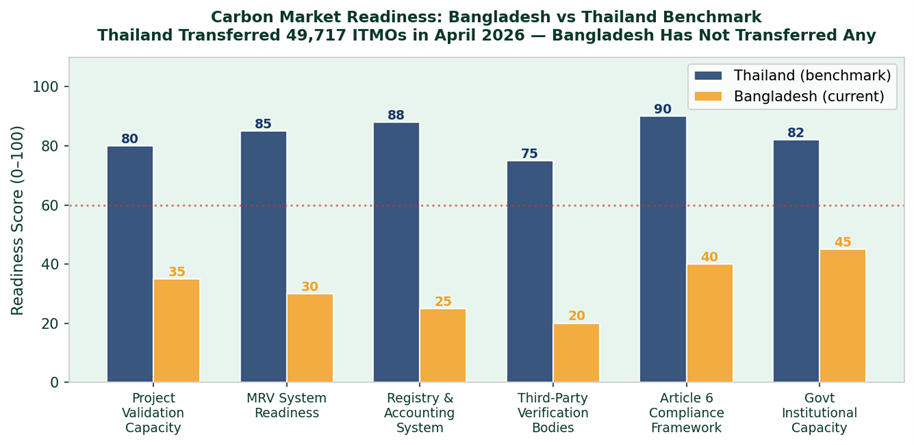
Carbon market readiness: Bangladesh vs Thailand benchmark across 6 MRV dimensions — Thailand transferred 49,717 verified ITMOs in April 2026; Bangladesh has transferred none
Bangladesh has the raw material for a substantial carbon market. The government is preparing to plant 250 million trees between 2026 and 2031, a programme that, properly verified, could generate significant carbon sequestration credits. IDCOL has already traded 1.6 million tonnes of carbon equivalents through the older Clean Development Mechanism, earning $17 million. Bangladesh’s solar home systems, clean cooking programmes, and methane capture initiatives each represent credible carbon reduction pathways. Analysts consistently estimate Bangladesh could generate more than $1 billion annually from carbon trading — a figure the PM’s special assistant cited publicly on May 19.
A marketable carbon credit is not just a tonne reduced. It is a tonne reduced and institutionally proven. Bangladesh has the emissions. The question is whether it can build the proof.
The critical distinction, drawn sharply in a recent TBS analysis, is between a carbon reduction that happens and a carbon reduction that is credible enough to be purchased by a sovereign buyer or corporate entity seeking to offset verified emissions. The difference is entirely institutional. Thailand’s Bangkok E-Bus Programme worked because every tonne reduced was tracked against a validated baseline, verified by an independent body approved under the Paris Agreement’s Article 6 framework, and registered with a corresponding adjustment that prevents Bangladesh or any seller from counting the same reduction twice once for its own Nationally Determined Contribution and again as a credit sold abroad.
Bangladesh’s institutional readiness for this standard is currently low. The Department of Environment published a Positive List and draft Article 6 framework for public consultation in early 2026, a necessary starting point. But the country lacks accredited verification bodies, a functioning national carbon registry aligned with Article 6 accounting rules, and a pipeline of projects that have passed the validation stage required for credit issuance. IDCOL’s CDM experience successful but limited provides a foundation. What is needed now is a national programme with the institutional depth to verify thousands of projects across sectors simultaneously.
The Bangladesh-Japan EPA signed in February 2026 includes provisions for environmental cooperation and technology transfer — a channel through which Japan’s advanced MRV expertise and carbon accounting infrastructure could be accessed. Bangladesh-Switzerland bilateral climate dialogues present a similar opportunity. The $1 billion in annual carbon revenue is achievable. The path runs through measurement, reporting, and verification systems that international buyers will trust. Building that trust is the governance task that determines whether Bangladesh’s carbon assets generate income — or simply reduce emissions that nobody pays for.