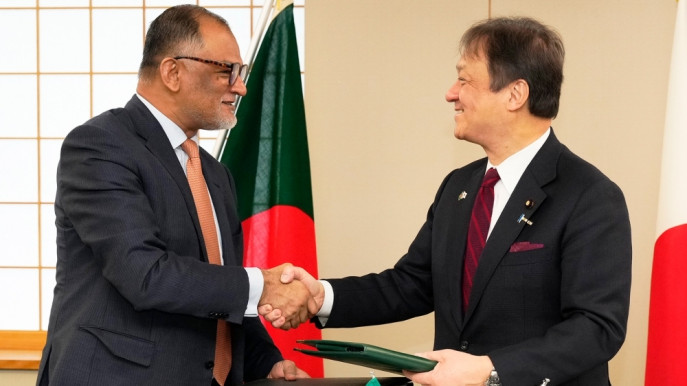
On February 6, 2026, in Tokyo, Bangladesh’s Commerce Adviser Sk Bashir Uddin and Japan’s State Minister for Foreign Affairs Horii Iwao signed the Agreement between Japan and the People’s Republic of Bangladesh for an Economic Partnership Bangladesh’s first-ever EPA and the first EPA Japan has signed with a Least Developed Country. The agreement, negotiated over seven rounds across Dhaka and Tokyo, came into effect upon official notification shortly after signing.
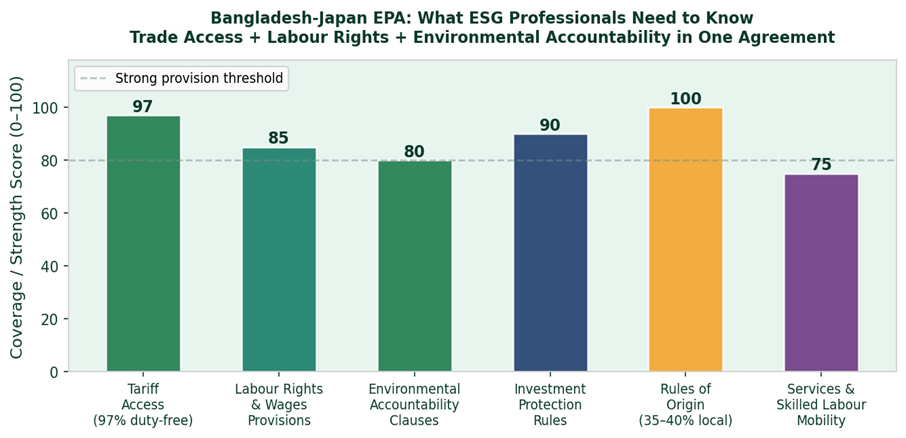
Bangladesh-Japan EPA: what ESG professionals need to know — 6 dimensions including tariff access, labour rights, environmental accountability, investment protection, rules of origin, and services mobility
The trade terms generated the headlines. Under the EPA, Bangladeshi exporters receive immediate duty-free access to 97% of their export basket to Japan including RMG, the sector that accounts for 80% of Bangladesh’s total exports. Japan is Bangladesh’s second-largest export destination in Asia, with exports reaching $1.33 billion in FY2024-25. The agreement also includes a single-transformation rule of origin for apparel: factories qualify for preferences with just 35-40% local value addition, even when key inputs such as fabric and yarn are imported. This gives Bangladesh’s RMG sector significant flexibility in how it structures its supply chain for the Japanese market.
Labour rights, environmental accountability, and sustainable development are written into the Bangladesh-Japan EPA. Trade compliance and ESG compliance are now the same obligation.
What received far less attention was the agreement’s governance architecture. The Prothom Alo analysis of the EPA text confirmed that the agreement contains specific provisions prioritising labour rights, fair wages, safe and healthy work environments, and social security for workers in both countries. Separate clauses require pollution control, natural resource conservation, and sustainable development maintaining environmental accountability alongside economic activity. Additional provisions require transparent and accessible government policies and regulations and simplified administrative processes.
These are not aspirational preamble language. They are operative provisions of a legally binding international agreement that Bangladesh has now ratified. Japanese buyers sourcing from Bangladesh will be able to reference the EPA’s labour and environmental provisions when requiring supplier compliance giving buyers a treaty-level foundation for ESG demands that previously existed only in voluntary codes of conduct or brand sustainability policies.
The EPA also establishes a framework for cooperation in services, investment protection, and skilled labour mobility creating a channel for Japanese technical expertise in environmental management, clean technology, and manufacturing process efficiency to enter Bangladesh more easily. The Bangladesh-Japan Chamber of Commerce and Industry President described the EPA as institutionalising a trade relationship that previously depended on unilateral preferences moving from dependency to partnership with legal certainty.
Every EPA Bangladesh signs next negotiations with the EU and UK are expected to accelerate following the Japan model will contain similar or stronger ESG provisions. The EU’s GSP+ scheme and the UK’s DCTS both explicitly condition preferential access on implementation of international labour and environmental conventions. Bangladesh’s EPA with Japan is the template. The companies and professionals that understand what ESG provisions in trade agreements require and how to demonstrate compliance are the ones whose export relationships survive every new agreement Bangladesh signs.