 Governance
After months of uncertainty, the UN General Assembly has extended Bangladesh's LDC preparatory period to 24 November 2029, without a vote. The EU called the extension exceptional and time-bound, and the government has published a reform roadmap it will be measured against. Exporters have breathing room, and a clear set of targets to use it.

Bangladesh has its breathing room. At the end of October, the UN General Assembly agreed, without a vote, to extend the country’s preparatory period for leaving the Least Developed Country list. Graduation, once set for 24 November 2026, now moves to 24 November 2029.
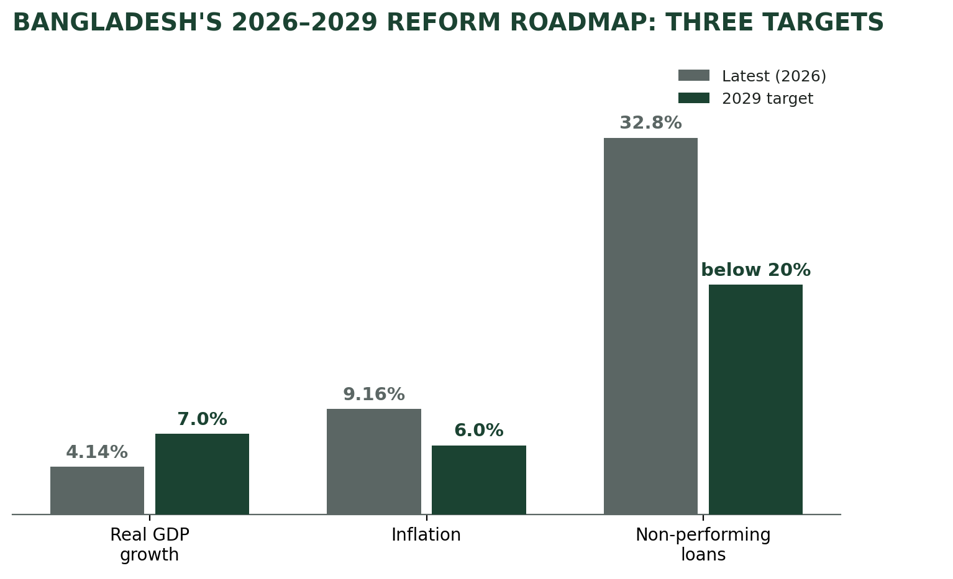
Three headline targets in the government’s 2026–2029 roadmap. The non-performing loan target is ‘below 20 percent’.
For exporters, this is a relief with real money behind it. One analysis puts the share of Bangladesh’s exports that benefit from LDC preferences at 73 percent. Clothing exports to the EU would face tariffs of around 12 percent after the transition, while competitors such as India and Vietnam pay none.
The EU backed the extension but described it as exceptional and time-bound. In return, Bangladesh has published a 2026–2029 roadmap that the EU and the UN are expected to monitor annually, with ministries reporting progress monthly.
The targets are measurable. Real GDP growth should rise to 7.0 percent by 2029 from 4.14 percent in 2026, and inflation fall to 6.0 percent from 9.16 percent. Non-performing loans, 32.8 percent of all loans in June 2026, should fall below 20 percent. The plan also aims for renewable energy to reach 16 percent of the energy mix by 2029, and includes an industrial energy security plan, support for non-garment exports and measures for women-led enterprises. Tax revenue was just 6.9 percent of GDP in 2025–26, and private investment 21.5 percent.
Many of these targets are about governance: the health of the banking sector, tax collection, the business environment and institutional accountability. The extension three years to turn a reprieve into reform, and recommended a public dashboard to track progress.
Whether the EU and the UN see delivery will depend on evidence, not intentions. Evidence needs data, data needs systems, and systems need people who know how to build and report them.
Three years is long enough to build that evidence, and short enough that the work has to start now.
Governance Governance
 Governance
Hivedemy turns ESG into short, hands-on lessons built and checked by professionals worldwide. Every lesson teaches first, then asks you to do the work, and every attempt gets a reason.