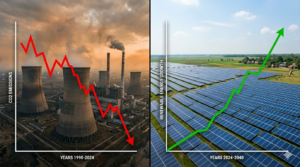
Bangladesh’s FY2026–27 budget contains one of the most important renewable energy decisions in the country’s history — and one of its biggest contradictions.
The headline reform is massive: the government has removed the 58.6% combined import duty on solar panels, inverters, lithium-ion battery packs, battery housing, and mounting structures until 2031. On top of that, solar power generation is now fully tax-exempt until 2035, while consumers and businesses using solar electricity receive a 5% tax rebate.
This is not a minor policy adjustment. It fundamentally changes the economics of solar adoption in Bangladesh.
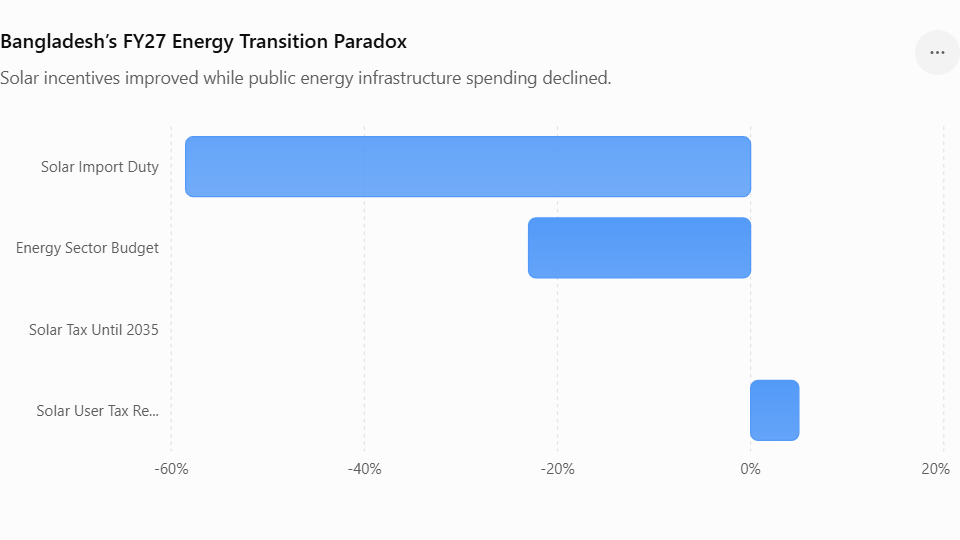
Solar incentives improved while public energy infrastructure spending declined.
For years, Bangladesh imposed one of the most self-defeating barriers in its clean energy journey: making solar expensive to import while simultaneously calling for renewable expansion. That contradiction is now gone.
And the timing matters.
Global buyers are increasingly demanding low-carbon supply chains. European carbon regulations are tightening. Energy security concerns remain elevated due to volatile fuel markets. For export-oriented sectors — especially manufacturing — energy is no longer just an operational cost. It is becoming a competitiveness issue.
The math now looks very different.
Factory owners who previously saw rooftop solar as a six-year payback investment may now see payback in three to four years. Projects that once struggled to secure board approval may suddenly become financially compelling.
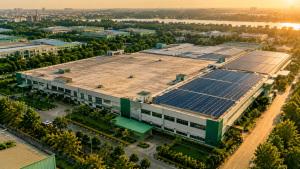
That matters because Bangladesh’s industrial rooftop solar sector has already crossed 500 MW — and it achieved that while the 58.6% duty was still in place.
Imagine what happens now that the duty is gone.
But this is where the story becomes more complex.
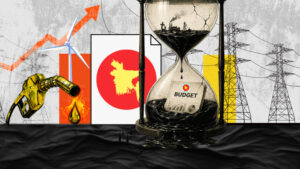
The same budget that gave solar its strongest fiscal support also reduced the power and energy sector capital budget by 23%, cutting allocation from Tk 22,520 crore to Tk 17,345 crore.
That raises an uncomfortable but necessary question:
Can Bangladesh accelerate renewable energy while spending significantly less on energy infrastructure?
Tax incentives attract private capital.
Government spending builds the infrastructure that private capital depends on.
Bangladesh successfully strengthened one. It weakened the other.
This distinction matters because not all solar is the same.
Rooftop solar on factories and commercial buildings is largely a private investment decision. Lower equipment costs and better financing can accelerate adoption quickly.
But large-scale energy transition requires far more than rooftop installations.
It requires:
- stronger transmission networks,
- modernized distribution systems,
- energy storage,
- grid flexibility, and
- infrastructure capable of handling two-way power flow under net metering systems.
Private factories do not build national grid infrastructure. Governments do.
That is where the 23% budget cut becomes significant.
Bangladesh has set a target of 10,000 MW of solar by 2030. Reaching that target would require roughly 7.4 MW of new solar installation every single day until the end of the decade.
That scale cannot be achieved through fiscal incentives alone.
Cheaper solar panels solve the affordability problem.
They do not automatically solve the infrastructure problem.
Still, the budget should not be read pessimistically.
The solar duty removal is a genuine breakthrough. It sends a clear signal to manufacturers, investors, banks, and project developers that renewable energy is no longer peripheral — it is moving toward the center of industrial strategy.
The next phase, however, is no longer about policy announcements alone.
It is about execution.
The real winners in this transition will not simply be the companies that install solar first. They will be the ones that understand how carbon, energy, finance, reporting, compliance, and operational strategy increasingly connect.
That capability gap is becoming one of Bangladesh’s biggest transition challenges.
The duty wall is down.
Now comes the harder part: building the systems, infrastructure, and expertise required to turn policy ambition into measurable transformation.
Bangladesh has made solar cheaper than ever.
The question now is whether the country can build an energy system ready to use it.