Renewable Electricity Share — Bangladesh vs. Regional Peers
| India | 30%+ | |
| Sri Lanka | 22%+ | |
| Pakistan | ~7% | |
| Bangladesh | <3% |
📊 The Gap to Close by 2030
| 1,700 MW Bangladesh’s current renewable capacity | 30,000+ MW Total installed generation base | 5,000+ MW Additional capacity needed to reach 20% |
| 760 MW/yr Required annual capacity addition | $933–980M Annual investment needed through 2030 | 39.9/100 ADB–WEF Energy Transition Readiness score |
Third time’s the charm — or is it? In 2008, Bangladesh promised 5% renewable electricity by 2015. It missed. In its next attempt, it aimed for 10% by 2020, and reached barely 3.5% of installed capacity. Now, under a February 2026 election manifesto pledge, the government is promising 20% renewable electricity by 2030 — and for the first time, the fiscal policy behind that promise has actual teeth.
The FY27 budget waives import duties, regulatory duties and advance taxes on solar panels, inverters and core components until 2031, alongside tariff relief for battery storage. For years, Bangladesh effectively taxed clean energy imports more heavily than fossil fuel infrastructure — the Centre for Policy Dialogue’s pre-budget assessment found LNG imports faced a total tax burden of just 9.5%, versus 61.8% for lithium-ion batteries and up to 93.2% for electric vehicles. That imbalance is finally being corrected, at least on paper.
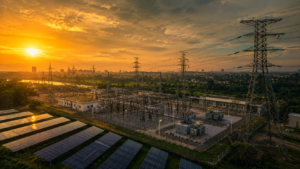
The scale of the challenge remains formidable. Bangladesh currently has roughly 1,700 MW of operational renewable capacity against a national generation base exceeding 30,000 MW — below 3% of the mix. According to the Institute for Energy Economics and Financial Analysis (IEEFA), hitting the 20% target on installed-capacity terms alone would require adding more than 5,000 MW in just over four years — nearly 760 MW every single year. For comparison, India already generates over 30% of its electricity from renewables, Sri Lanka exceeds 22%, and Pakistan sits near 7%. Bangladesh’s Energy Transition Readiness score from the ADB and World Economic Forum — just 39.9 out of 100 — is among the weakest in South Asia.
Two active pipelines — a National Rooftop Solar Programme targeting roughly 3,300 MW and utility-scale projects targeting around 5,500 MW — could together add nearly 8,800 MW of installed capacity, according to CPD’s Khondaker Golam Moazzem. But solar’s real-world capacity factor of just 20–22% in Bangladesh means effective output will fall well short of headline numbers.
Financing remains the binding constraint. IEEFA estimates Bangladesh needs $933–980 million annually in renewable investment through 2030, but Bangladesh Bank’s refinancing scheme is far too small to meet that scale, and commercial loans at 15% interest make most solar projects financially unviable. Bangladesh’s B2 sovereign credit rating and the memory of 31 renewable energy projects cancelled during the interim government period continue to weigh on investor confidence. Meanwhile, over 40 gas-fired power plants remain in the development pipeline — a sign that fossil-fuel infrastructure still competes hard for the same budget space.
Land scarcity is pushing experts toward rooftop and floating solar as the more realistic path forward — the IFC estimates Bangladesh could generate up to 11,000 MW through floating solar alone, though the regulatory framework for it remains immature. Whether 2030 becomes the year Bangladesh finally hits a renewable energy target, or the third missed deadline in a row, will depend less on ambition and more on financing structures, grid readiness, and policy consistency that outlasts a single budget cycle.