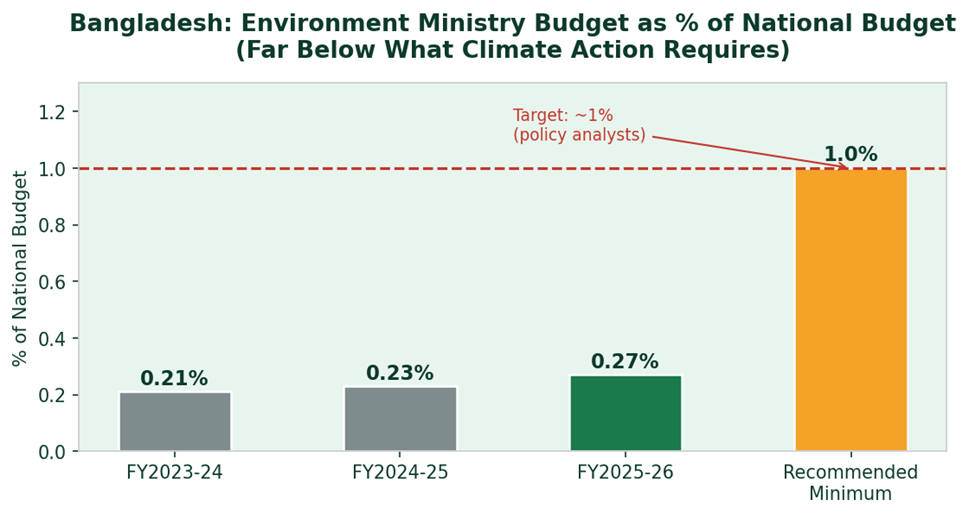
📊 Bangladesh Environment Ministry budget as % of national spend — far below the ~1% minimum policy analysts recommend
Bangladesh ranks 13th in the world on the Long-Term Climate Risk Index. Over the past two decades, 185 extreme weather events have caused 11,450 deaths and Tk 372 crore in economic losses. The country loses approximately 0.4% of GDP annually to heat stress alone. It is one of the most climate-exposed nations on earth.
In FY2025–26, the Ministry of Environment, Forest and Climate Change received 0.27% of the national budget.
Policy analysts say it should be around 1%. The gap between those two numbers — 0.27% and 1.00% — is the gap between what Bangladesh says about climate change and what it actually funds.
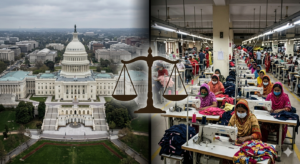
This is a governance problem. And governance is the ‘G’ in ESG.
The analysis is sobering. In the previous fiscal year, FY2024–25, overall Annual Development Programme spending fell to just 68% of allocation — the lowest figure in 49 years. Development spending in the first half of FY2025–26 reached only 17.54% of the annual target. The institutions charged with implementing environmental policy are underfunded and under-executing simultaneously.
The previous interim government, which held power from August 2024 to February 2026, struggled to maintain the policy momentum built up over decades of environmental governance development. Now, with an elected government in place, there is an opportunity to reset — but the institutional and financial gaps are real and deep.
The new government’s election manifesto includes commitments to tree planting, waste management, and river restoration. These are welcome. But they are individual actions, not a governance framework. Planting trees without enforcement capacity, water management without cross-ministry coordination, and climate finance without absorption capacity will not shift Bangladesh’s trajectory.
What would a genuine commitment to environmental governance look like? Three things, primarily.
First, budget: the Environment Ministry needs to receive meaningfully more than 0.27% of national expenditure. Reaching 0.5% in the next budget would be a signal. Reaching 1% within three years would be transformative.
Second, coordination: the climate agenda sits across the Ministry of Environment, the Ministry of Finance (climate finance), the Ministry of Power (energy transition), the Ministry of Commerce (trade compliance), and the Bangladesh Bank (sustainable finance). None of these are talking to each other systematically. A national ESG and climate coordination mechanism — potentially housed in the Chief Adviser’s Office — is overdue.
Third, institutions: regulatory bodies like the Department of Environment need sufficient staff, independent authority, and real enforcement capacity. Environmental violations need to carry meaningful consequences.
For the private sector, this matters directly. A country with weak environmental governance creates uneven competitive conditions — companies that cut compliance corners gain short-term advantage over those that invest in ESG. Without government enforcement, voluntary ESG commitment is undercut by free-riders.
Bangladesh is asking international investors and buyers to trust that it can manage a $26 billion annual climate finance requirement, transition a grid away from fossil fuels, and qualify for EU GSP+ based on environmental compliance.
That trust starts with the budget. 0.27% says something. Make it say something different.