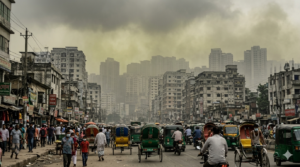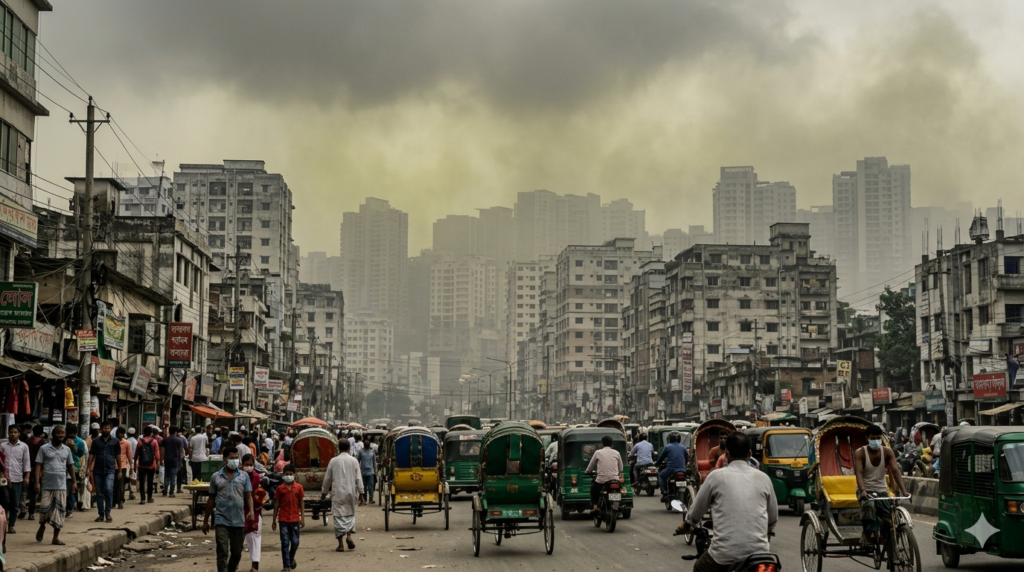
On the morning of Monday, May 11, 2026, the Air Quality Index in Dhaka registered 174 at 10:20am — placing the city at the top of IQAir’s global pollution ranking for that day. Delhi ranked second at 153. Tashkent and Hanoi followed. From May 1 to May 14, Dhaka appeared on the list of the world’s most polluted cities multiple times. This is not an anomaly. It is a pattern that has repeated across every dry season and — increasingly — even into the pre-monsoon months.
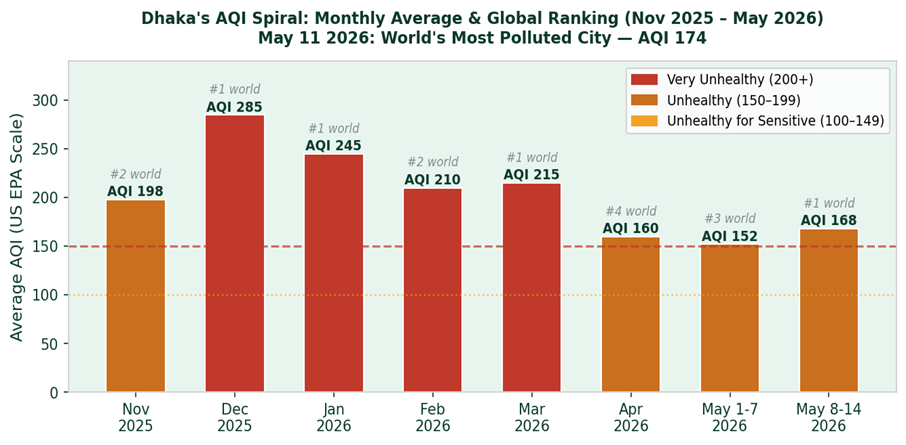
Dhaka monthly AQI averages and global ranking November 2025 – May 2026 — the city repeatedly topped the world pollution charts; May 11 2026 reached AQI 174 as #1 globally
The scale of the public health consequences has been measured. According to the World Bank, air pollution caused more than 159,000 premature deaths in Bangladesh in 2019 alone — nearly 55% of all premature deaths linked to environmental risks in the country. Dhaka’s annual PM2.5 concentration exceeds the World Health Organization’s guideline by more than 13 times, according to IQAir’s 2025 national rankings. The economic cost — measured through healthcare expenditure, lost labour productivity, and reduced output — amounts to approximately 8.3% of Bangladesh’s GDP, the World Bank estimates.
8.3% of Bangladesh’s GDP. That is the World Bank’s estimate of the economic cost of air pollution. No infrastructure investment programme in Bangladesh’s history has attempted to address a drag of this magnitude.
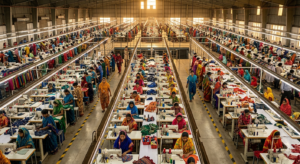
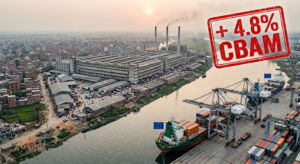
The sources of Dhaka’s pollution crisis are well-documented and institutionally intractable. Environmental experts point to four primary drivers: unchecked construction dust from Dhaka’s continuous urban expansion; smoke from brick kilns — an industry that operates on an outdated technology model that cleaner alternatives have already replaced in Bangladesh’s peer economies; industrial emissions from factories across the industrial belts of Gazipur, Savar, and Narayanganj; and transboundary pollution flowing into Bangladesh from the Indo-Gangetic Plain through prevailing wind patterns.
The governance gap is equally well-documented. Bangladesh’s Department of Environment has 67 air quality inspectors against a sanctioned strength of 157. The legal framework requires industry to comply with emission standards, but monitoring is intermittent and enforcement is inconsistent. Companies in Bangladesh’s formal sector — including listed companies, export-oriented manufacturers, and banks — currently face no mandatory requirement to measure, report, or disclose their contribution to ambient air pollution in any standardised ESG reporting format.
This is the ESG accountability gap that climate-focused sustainability frameworks have not yet closed in Bangladesh. Global reporting standards track Scope 1, 2, and 3 greenhouse gas emissions. Almost none require localised air quality impact reporting — the PM2.5, NOx, and SO2 contributions that are directly responsible for the premature death toll. Bangladesh’s transition to mandatory ESG reporting — currently in motion at BSEC and the FRC — is an opportunity to include air quality disclosure as a material sustainability metric. The cost of breathing in Dhaka is being borne by 22 million people. It should appear on someone’s ESG report.