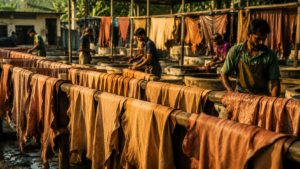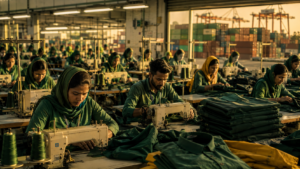
On January 27, 2026, India and the European Union concluded a comprehensive Free Trade Agreement dubbed the ‘mother of all deals.’ The pact eliminates duties on more than 99% of Indian exports to the EU — including apparel and textiles, which previously faced tariffs of 9–12%, and leather and footwear, which faced up to 17%.
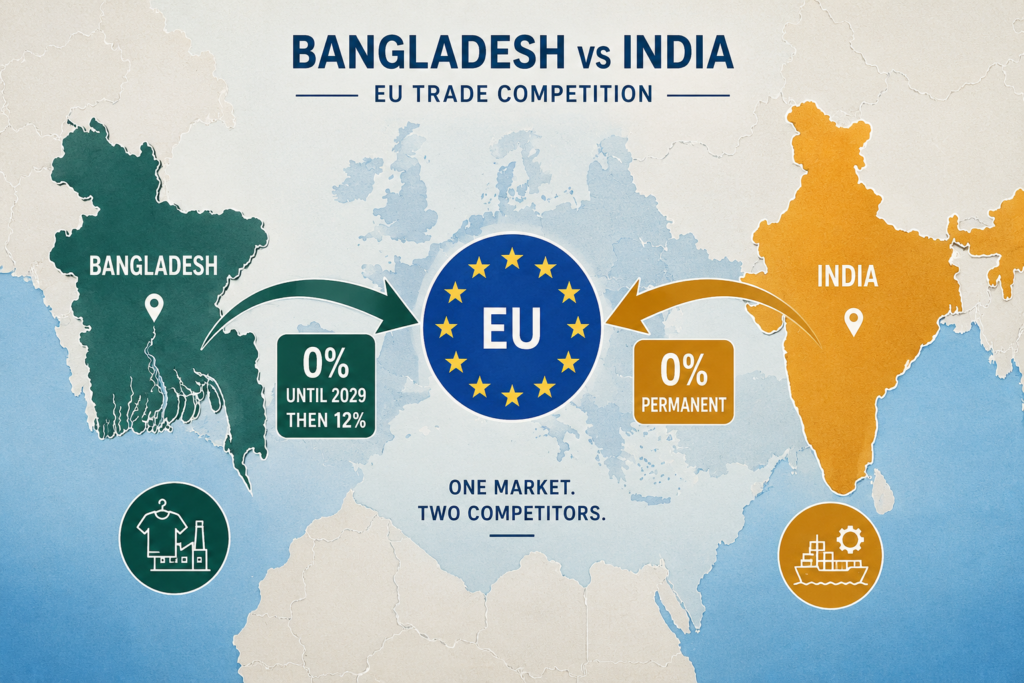
For Bangladesh, the implications are severe. Bangladeshi garments entered the EU duty-free under the Everything But Arms scheme for least-developed countries, while Indian goods faced those 9–12% tariffs. That margin — a structural price advantage — is now gone. India has a vertically integrated ‘cotton-to-garment’ supply chain that Bangladesh cannot match. Bangladesh imports over 85% of its raw materials.
The timing compounds the damage. Bangladesh graduates from LDC status in November 2026. During a three-year transition period, duty-free access continues. But from November 2029, if Bangladesh has not secured GSP+ eligibility or a bilateral arrangement, tariffs on Bangladeshi apparel could snap back to approximately 12% — exactly when India pays zero. Modelling by RAPID estimates garment export losses of over $5.7 billion in that scenario, and a 36.5% total export decline under GTAP simulation.
Trade analysts are clear: the response must go beyond tariffs. EU due diligence laws, mandatory sustainability disclosures, CBAM carbon pricing, and the Digital Product Passport create a multi-layered compliance environment. A Bangladesh that can demonstrate ESG credibility — environmental performance, social standards, transparent governance — has a differentiating argument even at tariff parity. Without that, price competition alone against India and Vietnam will be very difficult to win.
THE TARIFF GAP — BEFORE AND AFTER
| Country / Scenario | EU Tariff on Garments | Status |
| Bangladesh — now (EBA scheme) | 0% | Active until Nov 2029 |
| Bangladesh — post-2029 if no GSP+ | ~12% | Cliff edge risk |
| India — pre-FTA (MFN tariff) | 9–12% | Now eliminated |
| India — post-FTA | 0% | Permanent |
PROJECTED EXPORT IMPACT — RAPID & GTAP MODELLING
| Export loss — LDC prefs retained $190M garment decline from India FTA alone | Export loss — post-graduation, no GSP+ $5.7B+ combined impact of FTA + LDC loss | GTAP export decline scenario 36.5% total exports if facing MFN vs India at 0% | EU share of Bangladesh exports ~50% nearly all in textiles & apparel |