
 ESG Frameworks
S&P Global counts 35 jurisdictions that had adopted ISSB standards by 22 July, up from 28 in April, with 11 more planning to follow. Bangladesh's Financial Reporting Council is among the 2026 adopters. The map is filling in fast, though not everyone is heading the same way.
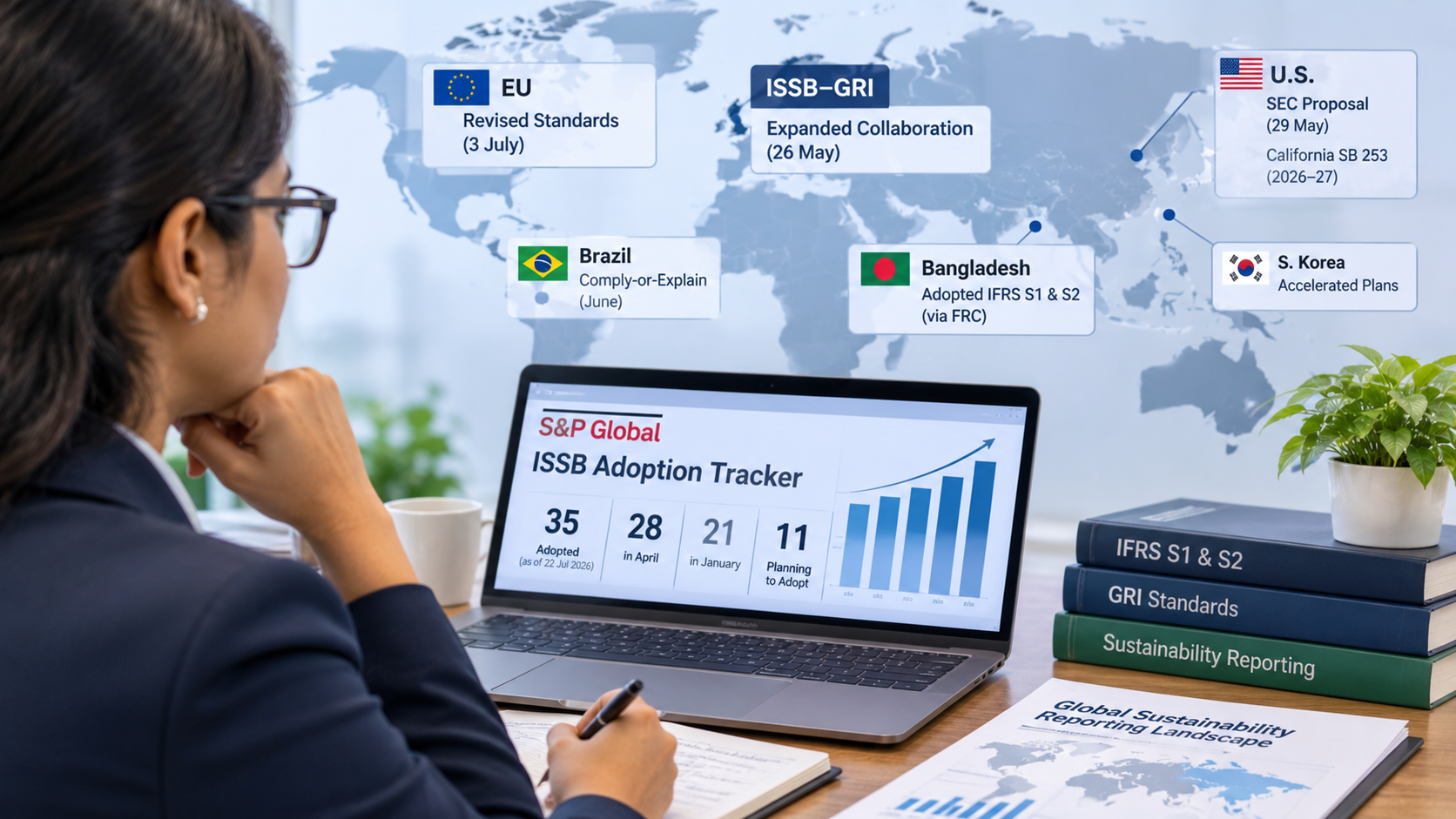
The global baseline for sustainability reporting is no longer a proposal. S&P Global’s latest tracker counts 35 jurisdictions that had adopted the ISSB’s IFRS S1 and S2 standards as of 22 July 2026. That is up from 28 in April and 21 in January. Another 11 are planning to adopt.
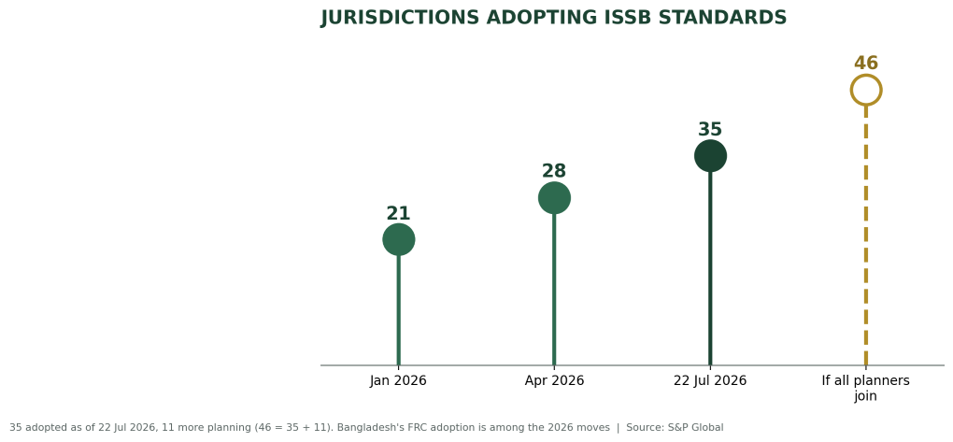
Adoption count from S&P Global’s quarterly tracker. The figure of 46 is the 35 adopted plus the 11 planning to adopt, and assumes all of them follow through.
Bangladesh is on the list. The report cites the Financial Reporting Council’s adoption of S1 and S2 following a consultation. Banks have been on this path since a 2023 central bank circular. The date from which listed companies must apply the standards is still worth confirming in the FRC’s circular.
The direction is not uniform. In June, Brazil’s securities regulator moved away from making the standards mandatory and adopted a comply-or-explain approach. South Korea, meanwhile, accelerated its plans, citing the Middle East energy conflict.
The frameworks around the ISSB are converging. The ISSB and GRI agreed to expand their collaboration on 26 May. The EU adopted revised reporting standards on 3 July after narrowing the scope of its rules in March, with the stated aim of working alongside the ISSB’s standards.
The United States is the contrast. The SEC proposed rescinding its climate rules on 29 May. Yet California’s SB 253 requires large companies to report Scope 1 and 2 emissions from 10 November 2026 and Scope 3 from 2027, and the state regulator has said it will promote interoperability with IFRS S2. Scope 3 covers emissions across a company’s supply chain, so suppliers should expect data requests from buyers that fall under such rules.
Keeping pace with evolving standards is an organisational responsibility. An organisation must have designated people tracking regulatory changes, translating requirements into action, and briefing the board on their implications.
ESG Frameworks Energy
 ESG Global Trends
Hivedemy turns ESG into short, hands-on lessons built and checked by professionals worldwide. Every lesson teaches first, then asks you to do the work, and every attempt gets a reason.