A peer-reviewed preprint published on Research Square in June 2026 has produced the first primary-data carbon and water footprint inventory of Bangladesh’s ready-made garment (RMG) sector. Covering 32 representative factories across knit, woven, and denim product lines, the study finds a sector-weighted mean carbon footprint of 16.0 kg CO₂-equivalent per kilogram of finished garment (cradle to gate).
Where does that carbon come from? Upstream activities — fibre and yarn production, mostly imported — contribute about 42%. Grid electricity accounts for 27%, onsite combustion and effluent treatment 25%, and export freight 6%. The mean blue-water footprint is 136 litres per kilogram; grey-water footprint 119 litres per kilogram.
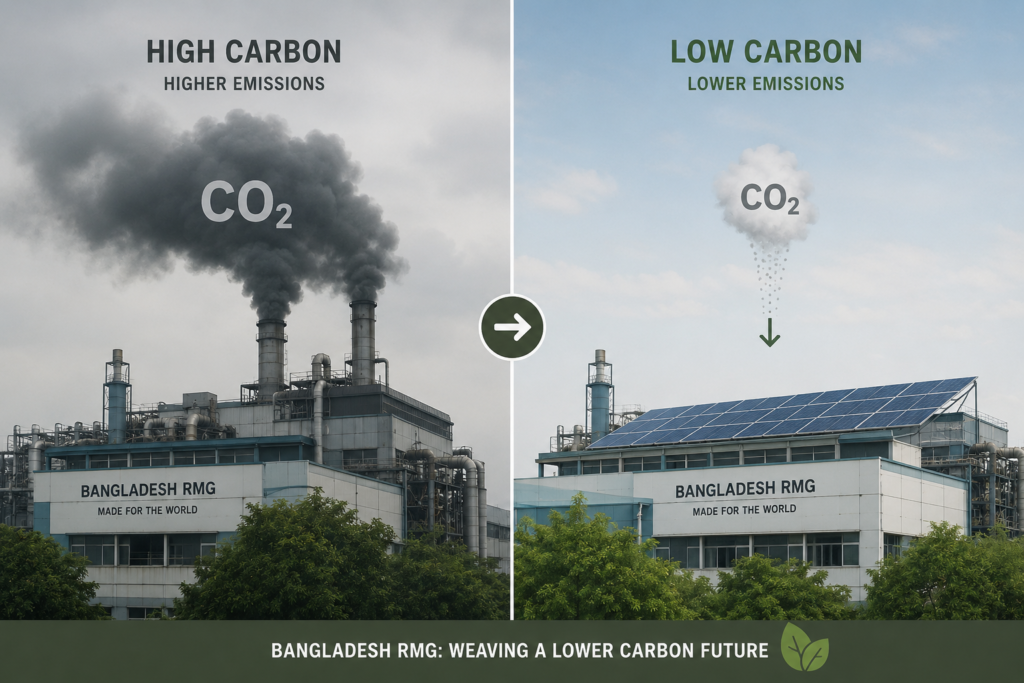
The EU’s Carbon Border Adjustment Mechanism (CBAM) entered its definitive, financially binding phase on January 1, 2026. Garments are not currently in scope, but the European Commission has signalled its intention to extend CBAM to downstream products across the decade. At a CBAM certificate price of €100 per tonne CO₂, the study models an exposure of approximately 4.8% of free-on-board export value under business as usual. A modelled decarbonisation pathway — combining energy efficiency, rooftop solar, renewable PPAs, process-heat electrification, low-impact dyeing, and recycled-fibre substitution — reduces that exposure to approximately 1.3%. A 54% footprint reduction is achievable. But it requires strategy, investment, and verified measurement. Bangladesh’s exporters cannot manage what they cannot measure.
CARBON FOOTPRINT BREAKDOWN — 16 KG CO₂ PER KG OF GARMENT
| Carbon source | Share of total | Key driver |
| Upstream — fibre & yarn production | 42% | Mostly imported from India, China |
| Grid electricity | 27% | Coal-heavy national grid |
| Onsite combustion & effluent treatment | 25% | Factory operations |
| Export freight | 6% | Shipping to EU markets |
CBAM EXPOSURE REDUCTION WITH DECARBONISATION
| Business as usual — CBAM exposure 4.8% of FOB export value at €100/t CO₂ | With decarbonisation pathway 1.3% 54% footprint reduction achievable | Blue-water footprint (wet processing) 136 L/kg of garment produced | Study factory coverage 32 factories knit, woven & denim |