On April 23, 2026, the Ministry of Commerce and UNIDO convened a national stakeholder consultation in Dhaka to advance Bangladesh’s draft National Strategy on Circular Economy for the Textile and RMG Sector — a 2026–2031 roadmap that represents the most significant attempted policy shift in how Bangladesh manages its largest industry’s environmental footprint.
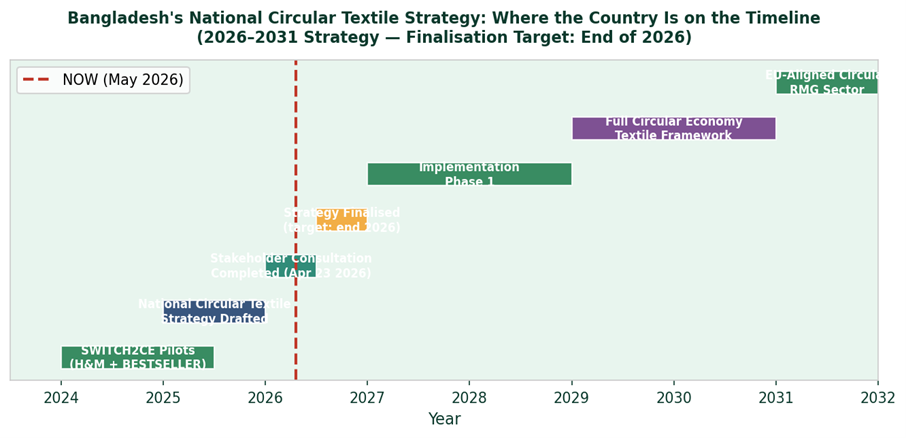
Bangladesh circular textile strategy timeline — from SWITCH2CE pilots (2024) through April 23 consultation to end-2026 finalisation target and 2031 full framework implementation
The consultation brought together Bangladesh’s three major garment industry associations — BGMEA, BKMEA, and BTMA — alongside the EU delegation, Chatham House, the European Investment Bank, and leading global brands including H&M Group and BESTSELLER. The unified message from the industry side was striking: BGMEA Vice-President Vidiya Amrit Khan stated that advancing circularity is ‘no longer optional but essential.’ BKMEA and BTMA representatives echoed this. The posture shift from industry bodies that have historically resisted compliance costs is itself significant.
‘Bangladesh stands at a pivotal moment. Developing a robust circular strategy is not only timely — it is essential to safeguarding our competitiveness.’ — Commerce Ministry Secretary, April 23 2026
The EU’s engagement reflects the commercial stakes. Hubert Blom of the EU delegation emphasised that circularity is a priority for Europe both domestically and in trade relationships — and that Bangladesh, as the EU’s dominant garment supplier, sits squarely inside the regulatory perimeter of the EU’s 2022 Strategy for Sustainable and Circular Textiles. This includes mandatory eco-design requirements, Digital Product Passports, extended producer responsibility, and binding greenwashing rules — all effective from 2028 to 2030.
The strategy’s substance covers five pillars: formal waste collection and management systems; recycling technology investment and incentives; supply chain traceability infrastructure; alignment with EU regulatory frameworks; and financial mechanisms for smaller manufacturers who cannot self-fund the transition. The blended-fibre recycling challenge — approximately 50% of Bangladesh’s textile waste is blended synthetic-natural fibre, which is technically far more complex to recycle than pure cotton — was flagged as the most urgent barrier that needs dedicated R&D investment.
The critical question is delivery. Bangladesh has a credible record of policy aspiration and a mixed record of policy implementation. The 10% renewable energy target for 2020 was not met. The leather sector CETP was promised in 2005 and completed almost two decades late. The 2002 polythene ban is still not enforced. A circular textile strategy that exists on paper but faces the same enforcement gaps, inadequate inspection capacity, and inconsistent political commitment would represent a missed opportunity that buyers will not wait another decade for Bangladesh to correct. The Commerce Ministry says technical reviews will validate the draft within the year. The EU, UNIDO, and the market are watching whether December 2026 becomes the date Bangladesh got serious about circularity — or another deferral.