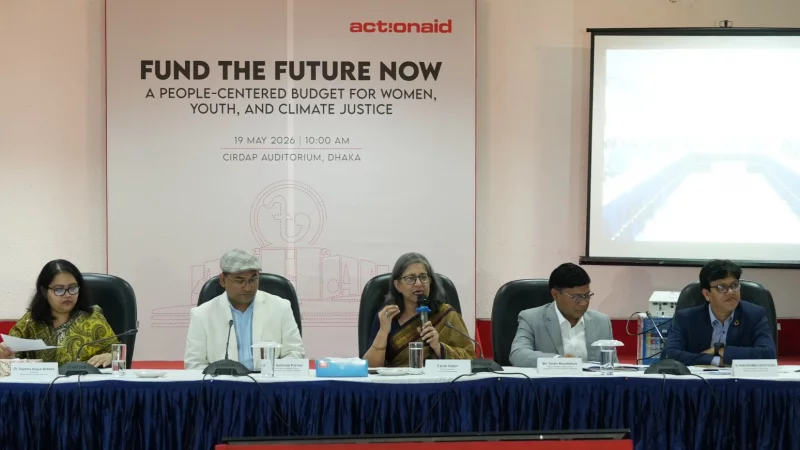
On May 19, 2026, civil society, economists, and government officials gathered at the CIRDAP Auditorium in Dhaka for a dialogue titled ‘Fund Our Future Now: A People-Centred Budget for Women, Youth and Climate Justice,’ organised by ActionAid Bangladesh. The event was timed with intention: the FY2026-27 budget framework is being finalised now, and the participants wanted their message heard before the numbers are locked.
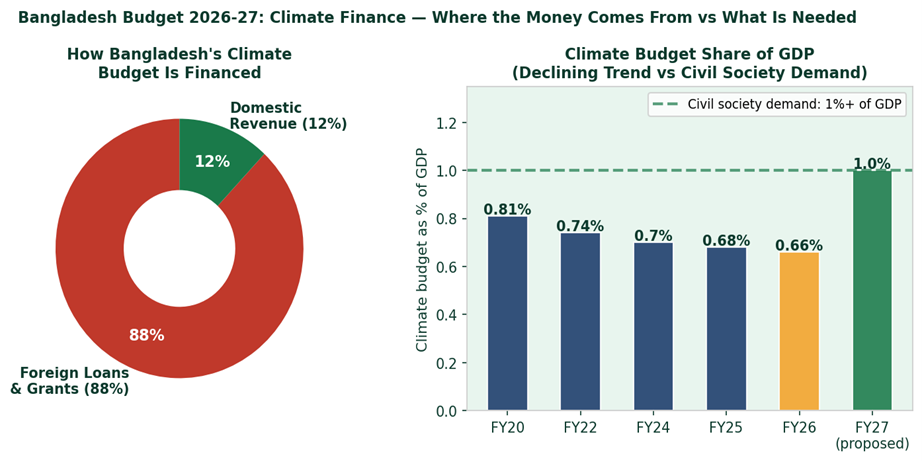
Left: 88% of Bangladesh’s climate finance comes from foreign loans — only 12% domestic. Right: climate budget as % of GDP falling steadily from 0.81% (FY20) to 0.66% (FY26), vs civil society demand of 1%+
The headline demand was specific: raise the environment ministry’s budget share from below 0.3% to at least 1% of the total. Context makes this demand more urgent than it sounds. Bangladesh ranks 7th globally on the ND-GAIN Country Index for climate vulnerability. It is already experiencing accelerating losses from flooding, cyclones, salinity intrusion, and heat stress. And yet as a share of GDP, climate budget allocations have fallen every year since FY20 from 0.81% then to 0.66% in FY26. The direction is moving opposite to the need.
88% of Bangladesh’s climate finance comes from foreign loans and grants. A country cannot build climate resilience on borrowed money it has to repay with interest.
The structural problem is dependency. The Dhaka Tribune’s analysis of the FY26 climate budget found that 88% of climate finance comes from foreign loans and grants. Domestic revenue finances only 12%. This means Bangladesh’s climate adaptation capacity is entirely contingent on the priorities, timelines, and conditions of international donors and lenders — who may redirect funds, apply conditionalities, or simply not disburse on time. Building genuine climate resilience requires domestic fiscal capacity, not perpetual external dependency.
The most significant statement of the day came from Dr Saimum Parvez, the PM’s special assistant on Environment, Forest and Climate Change. He confirmed that the government is expanding renewable energy, waste-to-energy, and carbon trading initiatives and specifically noted that carbon trading could generate nearly $1 billion annually if properly implemented. That figure is not aspirational. Multiple studies by the Institute for Energy Economics and Financial Analysis, LightCastle Partners, and the World Bank have confirmed Bangladesh’s potential in Article 6 carbon markets through forestry, solar, clean cooking, and methane capture.
The gap between that potential and realisation is institutional. Carbon markets require Measurement, Reporting and Verification systems that international buyers trust. They require a national registry, corresponding adjustment rules to prevent double-counting, and third-party verification capacity. None of these exist at adequate scale in Bangladesh today. The dialogue’s demand was that the FY27 budget allocate specific resources for building this institutional architecture not just the carbon trading aspiration, but the systems that make it credible.
Professor Sharmind Neelormi of Jahangirnagar University framed the core challenge: climate budgeting in Bangladesh must become more technically rigorous and knowledge-based to unlock global climate finance. The Green Climate Fund, the Adaptation Fund, and other international climate mechanisms reward countries with strong, verifiable, independently audited climate investment plans. Bangladesh currently receives a fraction of what its vulnerability should entitle it to because the institutional capacity to design, propose, and verify projects is not yet sufficient. The FY27 budget is an opportunity to begin closing that gap. The question is whether finance ministry officials reading the same data arrive at the same conclusion.