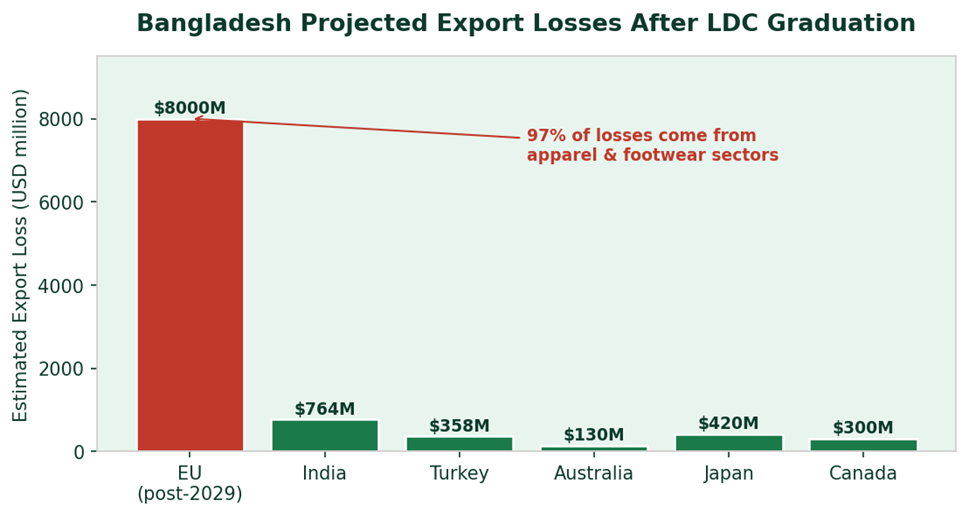
📊 Projected annual export losses by market after Bangladesh’s LDC graduation (USD millions)
Let’s start with the number that should be on every boardroom wall in Dhaka: $17.5 billion.
That is the estimated annual export loss Bangladesh faces once it graduates from Least Developed Country (LDC) status on November 24, 2026 — just 236 days away. The figure comes from UNCTAD’s Trade Preferences Outlook 2025, and it represents a 32.24% collapse in the country’s total goods exports. Ninety-seven percent of those losses would come from just two sectors: apparel and footwear.
If you work in garments, textiles, banking, or any sector plugged into global supply chains, this is not background noise. This is the single most important economic transition of your career.
Here is what makes this an ESG story, not just a trade story: Bangladesh does not lose access to the EU forever when it graduates. It becomes eligible for GSP+, the EU’s next-tier preference scheme that offers duty-free access for 66% of all tariff lines — including apparel.
But to qualify for GSP+, Bangladesh must ratify and effectively implement 32 international conventions. These cover human rights, labour rights, environmental protection, climate change, and good governance. That is the entire ESG framework, encoded into trade law.
The new BNP-led government has requested a three-year deferral, pushing graduation to 2029. Whether or not that request succeeds — and the UN is still reviewing it — the compliance clock is running. GSP+ accession is not a formality. The EU monitors it, enforces it, and has suspended it before for countries that fail to follow through.
So what does Bangladesh need to do? Start reporting. Transparently. Verifiably. Across the economy.
Bangladesh’s labour laws need to align with ILO core conventions. Environmental regulations need teeth. Corporate governance standards need to be enforceable, not aspirational. The Bangladesh Securities and Exchange Commission has made ESG reporting mandatory for listed companies, but enforcement and actual implementation remain paper-thin across most sectors.
The Policy Research Institute’s principal economist put it plainly: ‘The transition to a post-LDC regime will expose structural weaknesses, particularly our heavy reliance on a narrow set of products and markets. Without urgent credible reforms — securing trade agreements, improving logistics and energy reliability, and moving up the value chain — preference erosion could translate into real economic stress.’
Real economic stress. That is the diplomatic phrasing for factory closures, job losses for four million garment workers — the majority of whom are women — and a decade of hard-won development reversing course. The message for businesses is this: ESG is no longer a values statement. It is a market access instrument. Every company that wants to export to Europe post-2029 will need to demonstrate compliance with the same international standards that Bangladesh as a country must meet. The supply chain and the nation are being evaluated on the same scorecard.