Bangladesh’s banking sector just received its first-ever independent ESG report card.
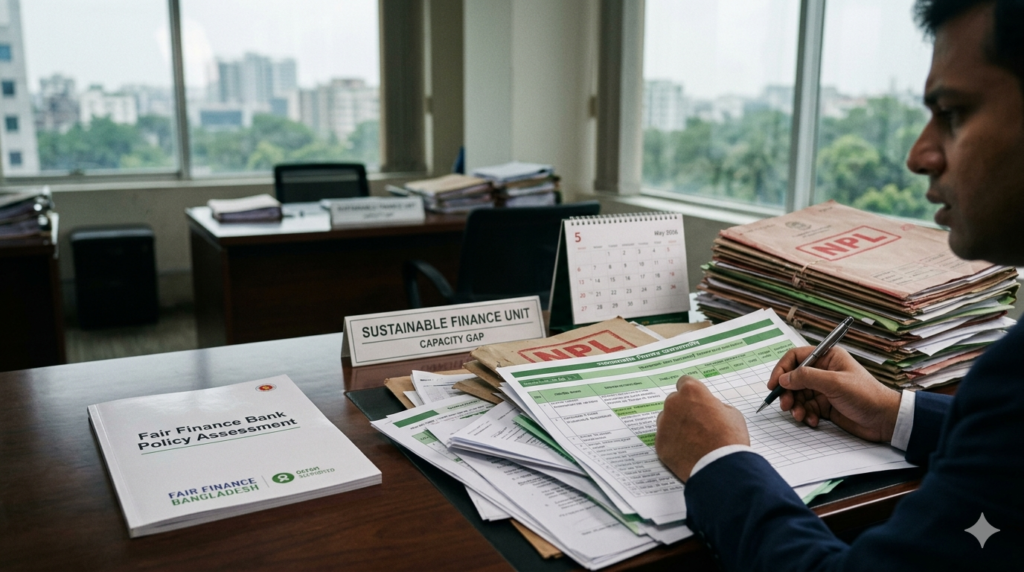
On 19 May 2026, Fair Finance Bangladesh, a coalition under the regional Fair Finance Asia network, supported by Oxfam in Bangladesh and PRAAN, publicly launched its inaugural Bank Policy Assessment Report. Using the globally recognised Fair Finance Guide International (FFGI) methodology, the assessment evaluated three of Bangladesh’s most prominent private commercial banks – City Bank PLC, BRAC Bank PLC, and Eastern Bank PLC against international ESG standards across themes including climate, human rights, labour rights, gender equality, corruption, and transparency.
I was in the room. Here is what the data tells us and what it doesn’t.
The Framework Exists. The Execution Doesn’t.
Bangladesh Bank deserves genuine credit for its regulatory architecture. Since introducing the Green Banking Guidelines in 2013, followed by the Environmental and Social Risk Management (ESRM) Guidelines in 2017, and the landmark Sustainable Finance Policy in December 2020, the central bank has built one of South Asia’s most progressive sustainable finance frameworks. The IFC has recognised Bangladesh as a regional leader in adopting green finance policies.
As of the latest quarterly data, 56 out of 61 scheduled banks now report exposure to sustainable finance , a remarkable breadth of adoption. Bangladesh Bank has set a 2025 green finance target of Tk 678.21 billion for banks and finance companies, with a sustainable finance target of Tk 5.43 trillion.
But there is a persistent and widening gap between policy ambition and portfolio reality. The FFB assessment found that banks met only 11.6% of their annual green finance target in 2025. This isn’t a rounding error. It is a structural failure.
The Numbers Behind the Narrative
The FFB report assessed the three selected banks across nine mandatory core themes using rigorous desk-review and stakeholder validation. The biodiversity score across all three banks averaged 3.2 out of 10. The assessment found no biodiversity footprint disclosure, no portfolio-level impact assessment, and no supply chain biodiversity obligations at any of the three institutions.
These are not obscure requirements. They are part of the IFC Performance Standards and international ESG baseline expectations that global investors, MDB partners, and development finance institutions now use as a precondition for engagement.
The irony is that these three banks are Bangladesh’s sustainability leaders. BRAC Bank, City Bank, and Eastern Bank all feature in Bangladesh Bank’s top sustainability-rated institutions for 2024 , evaluated on the Sustainable Finance Index, CSR activities, green project financing, and core banking sustainability. BRAC Bank topped Bloomberg’s ESG Rating 2024 among all Bangladeshi organisations with an overall score of 3.8, with Eastern Bank reporting that green lending accounted for 35% of its total term loan portfolio in 2024.
If these are our best performers, the sector-wide gap is even larger than the headlines suggest.
The Crisis Underneath
The sustainability gap does not exist in isolation. It sits inside a banking sector under acute stress.
Non-performing loans in Bangladesh’s banking sector stood at Tk 5.57 lakh crore at the end of December 2025, accounting for 30.60% of total outstanding loans among the highest NPL ratios in Asia. Analysis of central bank reports and research from leading institutions indicates Bangladesh now has one of the highest non-performing loan ratios in the world, with nearly 36% of loans turning non-performing at the peak in September 2025.
High NPLs erode capital buffers. Eroded capital buffers reduce appetite for long-term, patient lending exactly the kind that green and sustainable finance requires. Governance failures compound this: the FFB assessment explicitly identified corruption, weak transparency, and misaligned standards as systemic barriers to sustainable finance adoption.
As one expert quoted in the financial press noted, “Banks are still approaching sustainability largely as a compliance requirement rather than a business opportunity.”
This framing is precisely the problem.
The Real Bottleneck: People
The FFB report’s own findings are direct about the root cause. Financial sector employees lack awareness of green finance principles. Institutions lack the technical expertise to assess, structure, and report sustainable finance at the portfolio level. The sustainability taxonomy misalignment between Bangladesh and international MDB standards creates additional compliance friction, reducing Bangladesh’s attractiveness as a destination for green capital.
The report’s recommendations for addressing this include: nationwide training programmes for financial sector employees, dedicated sustainable finance units within institutions, and alignment of the Bangladesh sustainable finance taxonomy with global benchmarks.
These are not abstract policy recommendations. They describe a skills and knowledge gap one that can only be closed through structured, credentialed professional development tied directly to the frameworks being applied.
What Happens Next
The FFB assessment is expected to trigger bilateral meetings between Oxfam, PRAAN, and regulators, with a target of at least two banks committing to strengthen their public ESG policies within six months, and a Bangladesh Bank-hosted follow-up policy dialogue within three months.
This is the accountability cycle working as intended. A report lands. Banks see their scores. Regulators engage. Commitments are extracted.
But commitments without capacity are just more documents.
The missing link between policy architecture and portfolio execution, between regulatory intent and institutional practice is a trained, credentialed, practically equipped cohort of sustainability professionals embedded inside Bangladesh’s financial institutions.
That is the gap no policy brief can close on its own.