In April 2026, Thailand’s Bangkok E-Bus Programme transferred 49,717 Internationally Transferred Mitigation Outcomes — the formal unit of account under Article 6 of the Paris Agreement — to Switzerland. These were not theoretical emissions reductions. They were verified, registered, adjusted for double-counting, and transferred under a bilateral agreement. Thailand received payment. The transaction happened because Thailand built its Measurement, Reporting, and Verification infrastructure before it announced its revenue targets.
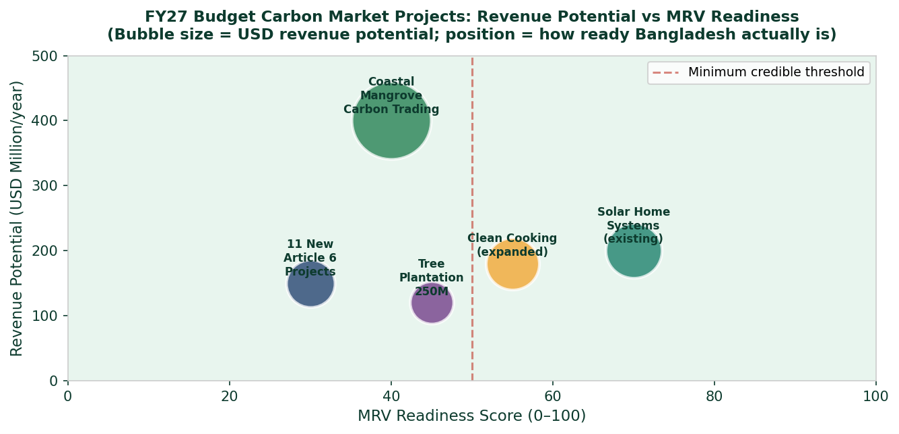
Carbon market project portfolio — FY27 budget commitment. Revenue potential vs MRV readiness. Bubble size = USD annual revenue potential. Coastal mangrove offers highest revenue but requires most institutional development. CDM-legacy solar is most ready to transact
Bangladesh’s FY2026-27 budget makes commitments that could, over time, deliver even larger carbon market revenues. Finance Minister Amir Khosru proposed 11 new Article 6 carbon market projects, a commitment to bring approximately half of Bangladesh’s coastal mangrove belt under a carbon trading framework, and a target of Tk 3.75 billion in annual carbon revenue. The PM’s special assistant on environment cited $1 billion as the annual carbon revenue potential if Bangladesh’s full asset base is properly developed and traded.
A carbon credit is not a tonne of CO₂ reduced. It is a tonne reduced AND independently verified AND registered AND adjusted to prevent double-counting. Bangladesh has announced the first. The rest is the work.
The gap between the revenue target and the institutional reality is significant. Bangladesh currently has a Positive List of eligible Article 6 project categories and a draft Article 6 framework that was circulated for public consultation in early 2026. What it does not have is a functioning national carbon registry aligned with Paris Agreement accounting rules, internationally accredited third-party verification bodies capable of certifying individual projects, or a pipeline of projects that have completed the independent validation required before credits can be issued.
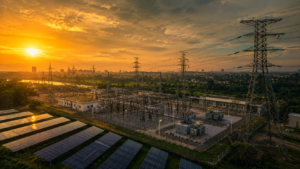
IDCOL’s Clean Development Mechanism track record — trading 1.6 million tonnes of carbon equivalents and earning approximately $17 million — provides proof of concept and institutional memory. But the CDM operated under rules that have been superseded by the Paris Agreement’s Article 6 framework, which imposes stricter requirements on corresponding adjustments and double-counting prevention. Bangladesh cannot simply apply CDM methodology to Article 6 projects.
The $1 billion annual carbon revenue is achievable on Bangladesh’s asset base — forestry, solar, clean cooking, methane capture, and industrial energy efficiency together represent a substantial carbon portfolio. The path to that revenue runs through MRV system development, accredited verifier training, and national registry establishment. These are the institutional investments the FY27 budget needs to fund alongside the 11 new project commitments. The budget has pointed at the revenue. The institutional architecture that generates it is the next task.